




10 Positive Habits of Highly Successful People (With Action Guide)
You know that feeling when you're scrolling through social media late at night, promising yourself that tomorrow will be different? That tomorrow you'll finally become an early riser, hit the gym, and start that side project? We've all been there. And if you're anything like I was, those promises often fade with the morning alarm.
Here's the thing about positive habits—they're not just about willpower or motivation. Habit formation is both simpler and more complex than most people think.
I learned this through my struggles with ADHD. For years, I saw my tendency to get distracted as a weakness, holding me back from building the habits I knew would improve my life. But then I discovered something fascinating: successful people don't have more willpower than the rest of us - they just understand how behavior change works.
Positive habits of highly successful people are small, repeatable actions that compound into extraordinary results over time. These include mastering a morning routine, protecting focus, prioritizing sleep, and learning daily. Rather than relying on willpower, successful people make these behaviors obvious, easy, and rewarding until they run on autopilot.
Upgrades You’ll Receive From This Blog:
Discover the answer to "What are some positive habits?" with a breakdown of the 10 most impactful habits to level-up your life.
Learn science-backed approaches to making these habits stick
Start putting the habits into action immediately with our modern, personalized AI habit formation system.

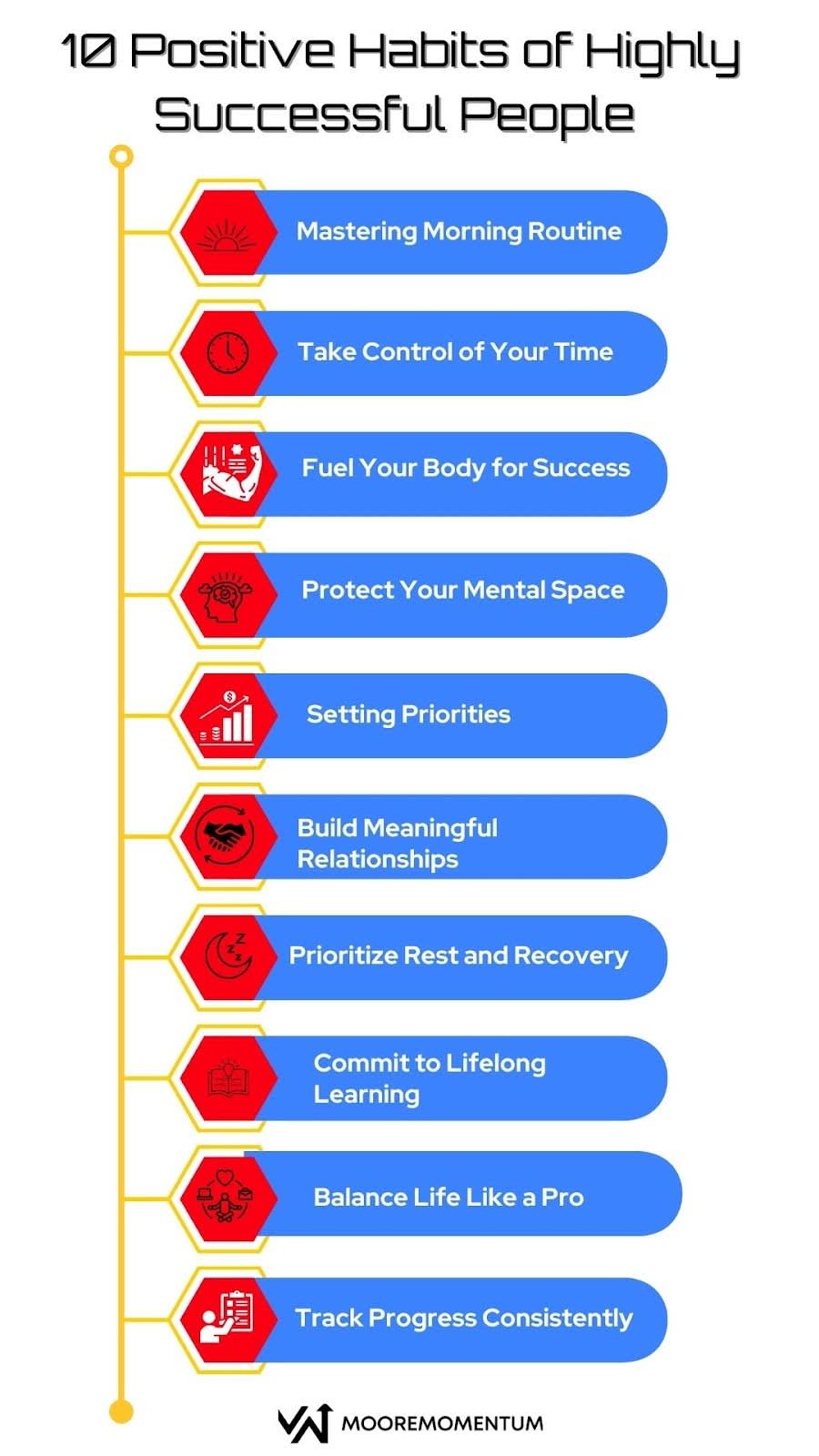
Top 10 Keystone Habits Of Highly Successful People
1. They Master Their Morning Routine
Your morning routine is one of the most powerful positive habits for success. It's not about torturing yourself with early wake-up calls - it's about taking control of your day before the day takes control of you.
I used to roll my eyes at "wake up at dawn" success stories too. My morning "routine" consisted of frantically checking emails while brushing my teeth, usually running late and feeling behind before my day even started.
3 Positive Habits To Support The Keystone Habit (And How To Make Them Stick)
Morning Mantra:
Successful people begin their day by setting a positive mental tone. Whether it’s a personal affirmation like “I create my own opportunities” or a list of the top 3-5 personalized reminders to overcome the pain points slowing your momentum.
Make It Obvious: Place a small note with your mantra on your bathroom mirror as a visual trigger to activate the habit.
Intentional Gratitude:
Taking just 60 seconds to acknowledge what you're grateful for activates your brain's reward system and releases good dopamine. This isn’t just feel-good advice—neuroscience shows that gratitude rewires your brain to recognize more positive patterns throughout the day.
Make It Easy: Stack your new habit onto an existing one like brushing your teeth. I.e.: “While I brush my teeth, I’ll repeat 3 things I’m grateful for.”
Not sure where to start with gratitude? Download your FREE Gratitude list to gain clarity.
Daily Goal Review And Prioritization:
The most productive people don’t just react to incoming demands—they proactively review their goals and set priorities before checking emails or notifications. This ensures your most important work gets your best energy.
Make It Easy: Take two minutes to list the ONE thing that you’ll commit today to achieve your goals tied to your weekly, monthly, and long-term goals. Keep it in an obvious place to ensure it gets done.
Are you prepared to transform your hectic mornings into a strategic roadmap for daily achievement? Grab our Morning Routine Checklist for Adults for FREE!
2. They Master Time, Not Let Time Master Them
I used to pride myself on "multitasking" while constantly feeling overwhelmed. My calendar was packed with meetings, my to-do list never-ending, and I'd end each day exhausted yet unsure of what I'd actually accomplished.
3 Positive Habits To Support The Keystone Habit (And How To Make Them Stick)
Time Blocking:
Successful people don't just list tasks – they schedule specific blocks of time for focused work on their most important priorities. This single shift transforms vague intentions into concrete commitments in your calendar.
Make It Attractive: Create a dedicated "focus zone" in your workspace that signals to your brain it's time for deep work. Remove all potential distractions and design an environment that concentrates effort on the path of least resistance.
Read More: 10 Good Working Habits
Regular Reviews:
Taking just 10 minutes weekly to evaluate how you spent your time versus how you intended to spend it creates awareness of patterns and helps you make strategic adjustments.
Make It Rewarding: After completing your weekly review, acknowledge what went well with a small reward (like your favorite coffee or brief entertainment). This creates a positive emotional association with the habit.
Strategic No's:
The most successful people understand that each "yes" is implicitly saying "no" to something else. They protect their time by carefully evaluating requests against their goals and values before committing.
Make It Obvious: Create a decision framework card with questions like "Does this align with my top priorities?" and keep it visible during meetings or when checking emails. This visual reminder helps activate intentional decision-making.
Learn more: Top 10 Habits of Successful People
3. They Treat Their Body Like a High-Performance Machine
Viewing your body as a high-performance machine is one of the foundational healthy habits that drives success. It's not about achieving perfect fitness or following rigid diets - it's about providing your brain and body with the optimal fuel, maintenance, and recovery they need to perform at their best.
I used to pride myself on "powering through" with minimal sleep, excessive caffeine, and whatever convenient food was available. The result was predictable: energy crashes, brain fog, and diminished capacity exactly when I needed to be at my best.
3 Positive Habits To Support The Keystone Habit (And How To Make Them Stick)
Strategic Nutrition:
Successful people approach eating as fueling their body's engine rather than simply satisfying cravings. They understand that what they consume directly impacts their energy, focus, and cognitive function - directly impacts their energy, focus, and cognitive function. What you eat at noon determines what you're capable of at 4pm.
Make It Easy: Prepare a nutrient-dense breakfast immediately after your morning routine. For example: "After I brush my teeth, I'll make my protein smoothie with greens." This leverages an existing habit to establish a new one.
Deliberate Recovery:
High performers recognize that rest isn't laziness—it's a crucial component of peak performance. Scheduling dedicated recovery time is what separates a career from a burnout cycle.
Make It Obvious: Create a dedicated "wind-down zone" in your home with comfortable seating, soft lighting, and calming elements. This environmental design naturally triggers relaxation and makes recovery the path of least resistance.
Quality Sleep:
The most effective leaders prioritize sleep as their performance superpower, and the science backs them up. Neuroscientist Dr. Matthew Walker, director of UC Berkeley's Center for Human Sleep Science, found that sleep deprivation can cut your brain's ability to form new memories by up to 40%, as he explains in his TED Talk Sleep Is Your Superpower. Successful people establish consistent sleep routines because they know rest directly drives cognitive function and emotional regulation.
Make It Rewarding: Reserve your favorite relaxing activities (reading fiction, listening to audiobooks, or gentle stretching) exclusively for your pre-sleep routine. This creates a positive anticipation that reinforces your commitment to sleep hygiene.
Read More: 7 Healthy Eating Habits
4. They Protect Their Mental Space Like a VIP Room
Guarding your mental environment is one of the most crucial positive habits you can build in our hyper-connected world. It's not about disconnecting completely - it's about being intentional with the information, influences, and energy you allow into your mind.
I used to consume content indiscriminately, mindlessly scroll, check notifications compulsively, and allow any thought or external stimulus to dictate my mood and focus. The result was predictable: mental clutter, fragmented attention, and emotional reactivity that undermined my effectiveness and well-being.
3 Positive Habits To Support The Keystone Habit (And How To Make Them Stick)
Information Diet Management:
Successful people carefully curate what they consume, understanding that mental inputs directly influence thinking quality. They're selective about news, social media, and content consumption, which is one of the best habits to adopt for clarity and focus.
Make It Difficult: Create strategic barriers to low-value mental inputs by removing social media apps from your phone, using website blockers during focused work, and scheduling specific times for news consumption rather than allowing random access.
Thought Awareness Practice:
High performers develop the ability to observe their thoughts without immediately reacting to them. This metacognitive skill is among the foundational skills that create emotional resilience and mental clarity.
Make It Obvious: Link brief meditation practices to existing daily activities: "After I pour my morning coffee, I'll take three conscious breaths and notice my current thought patterns." This creates regular check-points throughout your day.
Learn More: What is the Point of Meditation
Boundary Setting:
The most effective leaders establish clear limits around their time, energy, and attention. They practice saying no to distractions and interruptions, recognizing boundary-setting as the cheapest way to protect their mental bandwidth.
Make It Rewarding: After successfully maintaining boundaries (like completing a deep work session without checking messages), reward yourself with something enjoyable that reinforces the value of protected mental space.
Learn More: How to Become Stronger Mentally
5. They Focus on the Few, Not the Many
Concentrating on fewer, high-impact priorities is one of the defining daily habits of highly successful people. It's not about doing more things - it's about doing the right things with intensity and excellence.
I used to pride myself on my lengthy to-do lists and ability to juggle multiple projects simultaneously. The reality? I was making incremental progress on many things while achieving breakthrough results on none. I was busy but not productive, active but not impactful.
3 Positive Habits To Support The Keystone Habit (And How To Make Them Stick)
Regular Priority Auditing:
Successful people consistently review and refine what deserves their time and attention. They ruthlessly eliminate or delegate activities that don't significantly advance their core objectives, applying the Pareto principle that roughly 80% of results come from 20% of efforts.
Make It Obvious: Create a visible "focus filter" - a small card with your 1-3 highest-priority goals or values. Keep this in your workspace to reference when making decisions about how to allocate your time and energy.
Deep Work Blocking:
High performers schedule extended periods for uninterrupted, concentrated effort on their most important work. This structured approach to narrowing focus areas generates exceptional outcomes with less scattered effort.
Make It Easy: Design a dedicated deep work environment by removing potential distractions, preparing all necessary resources in advance, and creating visual signals to others that you're in focused mode. This environmental setup minimizes friction for sustained concentration.
Opportunity Filtering:
The most discerning leaders develop clear criteria for evaluating new opportunities, understanding that each "yes" diverts resources from existing priorities. Many use simple frameworks or productivity apps to objectively assess potential commitments against their strategic objectives.
Make It Rewarding: After successfully declining a non-aligned opportunity or delegating a low-leverage task, acknowledge the invisible win of protected focus. Track these instances and periodically review how this discipline has enabled progress on your true priorities.
Read More: The 10,000 Hour Rule
6. They Build Relationships Like They're Building a Fortune
Intentionally cultivating meaningful connections is what quietly distinguishes extraordinary achievers from merely busy ones. It's not about collecting contacts or transactional networking - it's about building a web of authentic relationships that create mutual value and support over time.
This isn't soft advice. The Harvard Study of Adult Development, which has tracked participants for over 80 years, found that the quality of our relationships is the single strongest predictor of long-term health and happiness. As study director Dr. Robert Waldinger puts it, good relationships keep us happier and healthier. Nothing else in the study came close, not wealth, not fame, not IQ.
I used to view networking as an uncomfortable necessity, focused on immediate utility rather than long-term connection. The result was predictable: shallow relationships that disappeared when circumstances changed, and missed opportunities for the deep collaboration that drives real innovation and growth.
Read More: Why is it Important to Build Strong Connections
3 Positive Habits To Support The Keystone Habit (And How To Make Them Stick)
Value-First Mindset:
Successful people approach relationships by looking for ways to contribute before seeking benefits. This relationship building approach of leading with generosity creates genuine connections based on trust rather than obligation.
Make It Obvious: Create a simple system for tracking meaningful details about important people in your life. Whether through a digital tool or physical notebook, regularly review these notes before interactions to demonstrate that you value the relationship.
Consistent Nurturing:
High performers understand that relationships require regular attention to thrive. They develop systems for staying in touch with their networking circles, recognizing that consistent small investments yield exponential returns over time.
Make It Easy: Link relationship nurturing to existing routines: "While having my morning coffee, I'll reach out to one person in my network with something of value." This embeds connection-building into your daily flow rather than making it another obligation.
Deep Listening:
The most connected leaders practice full presence and genuine curiosity in conversations. They ask thoughtful questions and truly absorb the answers, which is how enduring, meaningful relationships actually get built.
Make It Rewarding: After fully engaging in active listening during an important conversation, reward yourself with a simple pleasure you enjoy. This creates a positive reinforcement loop that strengthens your commitment to being fully present.
Read More: How do i become a better active listener in conversations?
7. They Rest Like Champions
Strategic recovery is the most underrated of all the habits of successful people, and it's what separates sustainable performance from burnout. It's not about being lazy - it's about recognizing that deliberate rest is as crucial to peak performance as focused work.
I used to wear exhaustion like a badge of honor, believing that rest was for the uncommitted. The result was predictable: diminishing returns, creative blocks, and a narrow perspective that limited both my effectiveness and enjoyment.
3 Positive Habits To Support The Keystone Habit (And How To Make Them Stick)
Boundary Setting:
Successful people create clear delineations between work and recovery time. They establish explicit recovery periods in their schedules and protect them as rigorously as their most important meetings.
Make It Obvious: Create distinct environmental shifts between work and rest modes. This might include changing locations, lighting, or even clothes to signal to your brain that you're transitioning to recovery time.
Active Recovery:
High performers understand that optimal rest isn't always passive. They engage in deliberate activities that replenish energy rather than deplete it, making strategic use of meditation techniques and other restorative practices.
Make It Fun: Pair restorative activities you need with experiences you crave. For example, only listen to your favorite podcast while taking a rejuvenating walk, or save a special snack for your meditation sessions. This phenomenon is called habit stacking.
Sleep Optimization:
The most effective leaders prioritize sleep quality as a competitive advantage. They design and protect their sleep environment and routines, recognizing that sleep hygiene directly impacts cognitive function, emotional regulation, and physical performance.
Make It Easy: Remove obstacles to quality sleep by preparing your sleep environment in advance. This might include setting out comfortable clothes, programming devices to enter do-not-disturb mode, or preparing sleep-supporting elements like cool room temperature and blackout curtains.
8. They Learn Like Their Life Depends On It
Continuous learning is the habit that compounds harder than any other over a lifetime. It's not about formal education or credentials - it's about cultivating an insatiable curiosity and commitment to growth that keeps you relevant and innovative in a rapidly changing world.
I used to think learning ended with formal education, approaching new skills reluctantly and only when absolutely necessary. The result was predictable: stagnation in my career, outdated perspectives, and missed opportunities as the world evolved without me.
3 Positive Habits To Support The Keystone Habit (And How To Make Them Stick)
Daily Learning Blocks:
Successful people schedule dedicated time for growth and skill development. They have a learning mindset. They treat these learning sessions as non-negotiable appointments with themselves, recognizing that consistent small investments compound dramatically over time.
Make It Easy: Link learning to existing daily routines by dedicating the first 20 minutes after lunch to reading industry publications or skill development. This leverages transition periods you already have rather than requiring new time blocks.
Strategic Skill Targeting:
High performers identify and prioritize learning that creates disproportionate value in their field. They focus on knowledge acquisition in areas with the highest potential impact rather than diluting their efforts across too many domains.
Make It Obvious: Create a visual "learning roadmap" that outlines your priority skills and place it where you'll see it daily. This constant reminder keeps your development goals front of mind and makes random learning less tempting.
Teaching What You Learn:
The most effective learners solidify their understanding by explaining concepts to others. Whether through formal teaching, mentoring, or simply discussing new ideas, sharing knowledge is the fastest accelerator of mastery there is. If you can't explain it simply, you don't own it yet.
Make It Rewarding: After successfully applying a new skill or sharing knowledge with others, document the experience in a "growth journal." Periodically review this record to visualize your progress and reinforce the value of your learning commitment.
9. They Balance Their Life Like a Master Chef
Creating balance and harmony across different life domains is what makes sustainable success possible in the first place. It's not about rigid equality in all areas - it's about intentionally allocating your time and energy based on your values and season of life, just as a chef balances flavors in a signature dish.
I used to swing between extremes – periods of all work and no play followed by burnout and neglect of professional responsibilities. The result was predictable: excellence nowhere, mediocrity everywhere, and a constant sense of failing in at least one important area.
3 Positive Habits To Support The Keystone Habit (And How To Make Them Stick)
Regular Life Audit:
Successful people periodically assess satisfaction and performance across their core life areas including career, relationships, health, and personal growth. This intentional review prevents unconscious neglect of any domain essential to their overall wellbeing.
Make It Obvious: Schedule quarterly "life balance" conversations with trusted friends or mentors who can provide honest feedback about how you're managing different domains. External perspective often reveals blind spots we miss on our own.
Intentional Transition Rituals:
High performers create deliberate boundaries between different life domains. They develop specific routines to help them mentally shift between roles and balancing priorities, allowing full presence in each area rather than mental fragmentation.
Make It Easy: Create distinct environmental cues for different domains of your life. This might include specific workspaces, playlists, or even clothing that signals to your brain which mode you're operating in, reducing the cognitive load of context-switching.
Value-Based Scheduling:
The most fulfilled individuals align their calendars with their personal core values.They proactively block time for their most important life balance priorities rather than hoping to find time for them after other obligations.
Make It Rewarding: Pair maintenance activities in neglected life areas with things you naturally enjoy. For example, combine family time with favorite outdoor activities, or blend physical exercise with engaging audio content you look forward to consuming.
Read More: How Can Managing Your Personal Life Help With Reaching Your Goals
10. They Track Progress Like Scientists
Measuring and evaluating results is the habit that makes every other habit on this list stick. It's not about obsessing over metrics - it's about gathering objective data that reveals what's working, what isn't, and where adjustments are needed to continue moving forward.
I used to rely solely on my subjective feelings about progress, creating ambitious plans but rarely evaluating my actual results systematically. The result was predictable: repeated mistakes, unclear trends, and goals that perpetually remained just beyond reach.
3 Positive Habits To Support The Keystone Habit (And How To Make Them Stick)
Consistent Measurement:
Successful people identify and regularly monitor key performance indicators in areas important to their goals. They establish baselines and track changes over time, recognizing that what gets measured is what improves. Research by psychology professor Dr. Gail Matthews at Dominican University of California found that people who wrote down their goals, shared them with a friend, and sent weekly progress updates were significantly more successful at achieving them than those who merely thought about their goals. Written tracking plus accountability is one of the defining habits of highly effective people.
Make It Easy: Select or create simple tracking tools that fit naturally into your routine. Whether digital apps or physical journals, the best system is one you'll actually use consistently rather than abandoning due to complexity.
Regular Review Rituals:
High performers schedule specific times to analyze their data tracking and extract insights. These deliberate reflection periods transform raw information into actionable wisdom that guides their next steps.
Make It Obvious: Attach your review ritual to an existing routine like Sunday morning coffee or Friday afternoon wrap-up. This creates a natural trigger for your analysis session and ensures it doesn't get overlooked.
Hypothesis-Based Experimentation:
The most effective achievers approach their goals with a scientist's mindset. They form theories about what might work, test them systematically, and adjust based on results, making progress tracking a dynamic tool for optimization rather than just scorekeeping.
Make It Rewarding: Create a visual representation of your progress journey - whether a chart, graph, or other display - and place it where you'll see it regularly. This tangible reminder of your improvement provides motivation during inevitable plateaus and setbacks.
Learn More: How to Track Habits
Conclusion: You Don't Need More Willpower. You Need Better Design.
Remember that late-night scroll from the beginning of this article? The one where tomorrow was finally going to be different?
Here's what I wish someone had told me back when I was making that promise every night and breaking it every morning: tomorrow was never the problem. My design was.
For years I thought my ADHD meant I was missing whatever the successful people had. Then I spent three decades studying them, and found something almost disappointing in how simple it was. They weren't grinding harder than me. They'd just quietly arranged their lives so the right move was the easy move. The gym bag by the door. The phone in the other room. The one priority written down before the inbox got a vote.
That's the thread running through all 10 habits above. Not discipline. Design.
And you don't need all ten. You need one.
Pick the habit from this list that made you wince a little, the one you already knew you'd been avoiding. Then make it obvious, make it easy, and make it rewarding enough that skipping it feels worse than doing it. Give it two weeks. When it stops requiring a decision, add the next one.
That's how momentum works. Not one heroic leap, but one small win that makes the next one slightly easier, until you look up a year later and barely recognize the person who used to lie awake promising himself tomorrow.
The habits above are the map. What most people are missing is the engine.
.🚀 YOU'VE GOT THE HABITS. NOW UNLOCK THE SYSTEM BEHIND THEM.
Every strategy in this guide, making habits obvious, easy, and rewarding, comes from the Moore Momentum System: a simple, science-backed, AI-personalized way to gamify your growth so consistency stops depending on willpower. Because here's what most people miss: these 10 habits don't live in isolation. They span all 5 Core Areas of your life, and the reason yours keep slipping is almost always a friction point hiding in the Core you've been ignoring.
👉 Take the Core Values Quiz and get your personalized Momentum Score in under 60 seconds. You'll instantly see which Core is quietly draining your progress, and which Golden Habit to build first for the biggest ripple effect.
SPARK YOUR MOMENTUM HERE!
🚀🚀🚀 Don't forget to check out our RESOURCE ARCADE 👾🎮 for FREE templates and tools to gamify your habits.

FAQs About the Habits of Highly Effective People
What are the 7 habits of highly effective people?
The 7 habits of highly effective people, from Stephen Covey's classic book, are: be proactive, begin with the end in mind, put first things first, think win-win, seek first to understand, synergize, and sharpen the saw. The 10 positive habits in this guide build on those timeless principles with modern behavioral science, because success itself is a habit you can develop.
What are the daily habits of highly successful people?
The most common daily habits of highly successful people include a structured morning routine, time blocking, daily learning, gratitude practice, and progress tracking. The key is consistency, not intensity. Even five minutes a day compounds. For a bigger menu of options, explore these 52 life changing habits and pick one to start.
How long does it take to build a positive habit?
Research from University College London found new habits take anywhere from 18 to 254 days to become automatic, with an average of 66 days. Complexity matters: simple habits form faster than demanding ones. Learn more about how many days it takes to form a habit and why the 21-day rule is a myth.
What is the most important habit of successful people?
If you had to pick one from the habits of successful people, choose the keystone habit that triggers the biggest ripple effect in your life. For most people that's mastering their morning routine, because it cascades into energy, focus, and follow-through everywhere else. Discover how to identify your own version by building golden habits into your daily routine.
How many positive habits should I start with?
Start with one. Stacking too many new behaviors at once splits your focus and drains willpower before any habit reaches autopilot. Master one habit until it feels automatic, then add the next. This is the fastest path to building discipline and consistency that actually lasts.


Founder & CEO of Moore Momentum
Will Moore is a serial entrepreneur, life coach, and habit science expert with a $300M+ exit under his belt. After hitting suicidal rock-bottom as a teen, he dedicated his life to cracking the code on lasting happiness and success — and built Moore Momentum to share what he found.
He helps people discover WHO they are, WHAT they really want, and HOW to get there by combining proven principles, science, AI, and gamification.
His mission: make growth ethically addictive and inevitable.