





How to Be a Better Listener in a Relationship: 9 Techniques That Work
There was a night I'll never forget.
My business was on fire, deals closing, momentum building, the kind of growth I'd been grinding toward for years. I came home buzzing. My wife tried to tell me something was wrong. Really wrong.
I nodded. I said "mmhmm" in all the right places. I was physically present but mentally still in the boardroom.
She stopped mid-sentence and said, "You're not listening to me."
She was right. And I had no good defense.
I thought I was a good communicator. I was confident. Articulate. I could hold a room. But being a good listener in a relationship? That was a completely different skill — one I hadn't bothered to build.
That conversation cost me more than the deal I'd been celebrating. It took real work, real humility, and a genuine commitment to change before I understood what it actually means to be a good listener — and what was at stake when I wasn't.
Here's what I've learned since: how to be a better listener in a relationship isn't about staying quiet. It's an active, trainable skill. And when you build it, everything — your connection, your trust, your partnership — levels up.
What you'll take away from this article:
Why being a good listener is the single highest-leverage relationship skill you can build
The real difference between hearing and listening (and why most people never cross that line)
What the three components of active listening actually are and how to use them daily
9 practical strategies to become a better listener, starting today
The most common listening mistakes that silently damage even good relationships
How to be a better listener in a relationship means giving your full attention, responding with genuine empathy, and making your partner feel truly understood. It's an active skill — not a passive one and it can be learned.
Most people think they're good listeners. They're not. They're just waiting for their turn to talk. Being a better listener isn't about staying quiet. It's about what you do while the other person is still talking: whether you're actually tracking what they mean, or already composing your reply. That gap is where most couples lose each other. It breaks down into three things you can actually practice — staying present when your instinct is to fix, processing what's underneath the words, and responding in a way that confirms you got it before you offer your own take. None of it is complicated. Most of it just requires slowing down more than feels natural.
Why Is It Important to Be a Good Listener in Relationships?
Being a good listener is fundamental to relationship success for several key reasons:
It builds trust and emotional intimacy by showing your partner they matter to you. Research by Dr. John Gottman, who studied thousands of couples over four decades, found that partners who feel heard are significantly more likely to stay together long-term.
Being a good listener prevents misunderstandings that often lead to unnecessary conflicts. Most arguments stem from miscommunication rather than genuine disagreements.
It helps your partner feel valued, respected, and supported. When you give someone your undivided attention, you communicate that their thoughts and feelings are important.
It gives you accurate information about your partner's needs and feelings, creating a foundation for mutual understanding and problem-solving.
Being a good listener strengthens your connection by fostering deeper conversations. A Harvard study found that couples who consistently practice empathy and active listening report deeper satisfaction and longer-lasting partnerships.
Good listeners aren't born—they're made through consistent practice. The techniques you're about to learn will help you develop this essential relationship skill.
So, Believe in Yourself, and I will walk you through the complete process of becoming a good listener. Ready? Let’s get started.
What Makes a Good Listener: Understanding the Basics
Before jumping into techniques, let's establish a foundation. Understanding the types of listening and core components will help you recognize where you currently stand.
The Difference Between Hearing and Listening
Hearing and listening are two very different processes:
Hearing is simply the physical act of perceiving sounds. It's involuntary and happens automatically when sound waves reach your ears. You can hear something without paying attention to it.
Listening is an active mental process that involves interpreting and understanding what you hear. It requires focus, concentration, and engagement. When you truly listen, you're not just receiving sound—you're processing meaning, emotions, and context.
Think of it this way: hearing is like having a book in front of you, while listening is actually reading and comprehending the words. In relationships, many couples hear each other speak but fail to truly listen to what makes a good listener stand out.
Types of Listening in Relationships
Not all listening is created equal. Understanding different types of listening helps you recognize which approach your relationship needs:
Active Listening:
Active Listening involves fully engaging with the speaker, asking questions, and providing feedback. This is the gold standard for being a good listener in relationships.
Passive Listening:
Passive Listening means hearing words without full engagement or processing. This superficial approach often leads to misunderstandings and disconnection.
Reflective Listening:
Reflective Listening is when you paraphrase what you heard to confirm understanding. This technique is particularly powerful for emotionally charged conversations.
Empathetic Listening:
Empathetic Listening focuses on understanding the emotions behind the words, not just the content. This creates deeper emotional connection.
Good listeners primarily use active, reflective, and empathetic listening to strengthen their relationships.
Passive listening | Active listening | |
Attention level | Partial — mind wanders, multitasking common | Full — phone down, eye contact, body turned toward partner |
Response style | Reacts immediately, often mid-sentence | Pauses, reflects, then responds thoughtfully |
What's processed | Words only — tone and emotion often missed | Words + emotion + body language + context |
Partner outcome | Feels unheard, dismissed, or misunderstood | Feels seen, valued, and emotionally safe |
Conflict impact | Misunderstandings escalate into unnecessary arguments | Misunderstandings caught early through reflection and clarification |
Long-term effect | Erodes trust and emotional intimacy over time | Builds deeper connection and relationship resilience |
What Are the Three Components of Active Listening
Understanding what are the three components of active listening gives you a framework for improvement:
1. Receiving (Paying Full Attention)
This means giving your undivided attention to your partner. Put away phones, turn off the TV, and focus completely on what they're saying. Notice their body language, facial expressions, and voice tone—not just their words.
2. Understanding (Processing Meaning and Emotions)
Go beyond surface-level comprehension. Ask yourself: What is my partner really saying? What emotions are they expressing? This requires empathy and perspective-taking.
3. Responding (Providing Appropriate Feedback)
What is the last step of active listening strategy? Responding with validation and understanding. This doesn't mean you have to agree—it means acknowledging that you heard and understood their perspective. Use paraphrasing, clarification questions, and phrases like "I hear you" or "That makes sense."

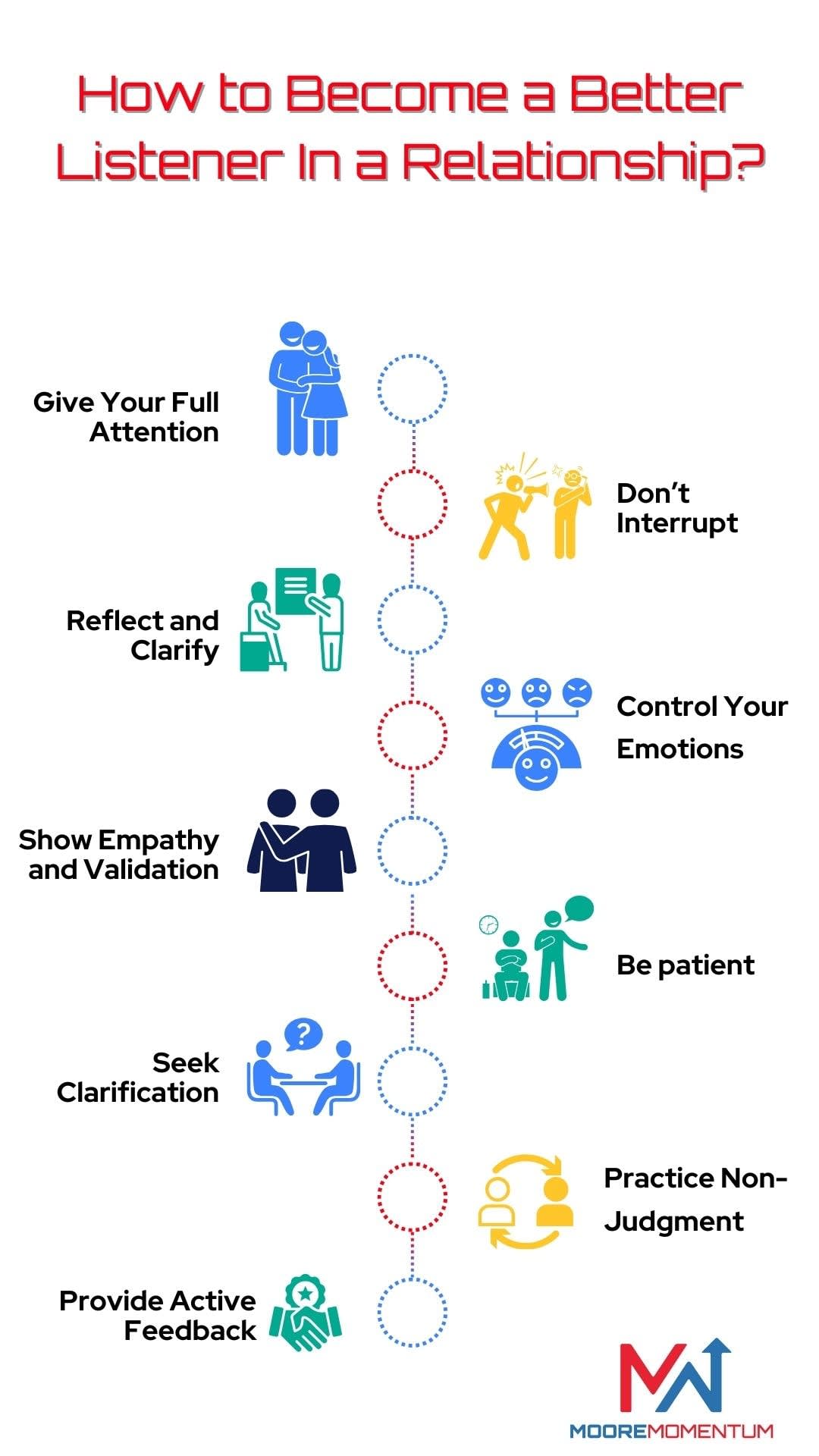
How to Be a Better Listener In a Relationship?
Want to understand how to be a good listener? Here are some practical tips you can start using today to be a good listener:
1. Give Your Full Attention
The first step in learning how to be a better listener in a relationship is also the most foundational: put the phone down. Turn away from the TV. Close the laptop. When your partner starts talking, let everything else fall away.
Make eye contact and angle your body toward them. Even small gestures — turning your phone face-down, pushing the laptop to the side — signal that this conversation matters more than whatever else is competing for your attention. In a world of constant notifications, giving someone your undivided presence has become one of the most powerful things you can offer.
Body language does more work than most people realize. Leaning in slightly, keeping your posture open, maintaining eye contact — these non-verbal cues communicate engagement before you've said a single word.
Think of this as your most foundational listening habit. The simple trigger of putting your phone face-down the moment your partner starts talking removes the friction that kills connection before it even starts. And here's what most people miss: small habits like this don't just improve one conversation. They quietly shift who you are as a partner and that shift has a way of spreading into every other aspect of life.
Read More About The Domino Effect
2. Good Listeners Don't Interrupt
Most people interrupt not because they're dismissive, but because they're already formulating their response while the other person is still talking. That "waiting to respond" trap means you're not listening better — you're just preparing your rebuttal.
The fix is deceptively simple: after your partner finishes speaking, count silently to three before you respond. That pause demonstrates respect. It gives them space to finish completely — and gives you a moment to actually process what was said rather than react to the first version of it.
Dr. Deborah Tannen's research found that interruptions are one of the most common communication complaints in relationships. The irony is that the person interrupting almost always believes they're being engaged and enthusiastic. Their partner experiences it as being dismissed.
Read More: How to Change the Way You Think
3. Reflect and Clarify
One of the most effective ways to be a good listener is to summarize what you heard before responding. It sounds like: "What I'm hearing is…" or "Let me make sure I understand correctly…" This technique — reflective listening — does two things simultaneously: it confirms you were paying attention, and it gives your partner the chance to correct any misunderstanding before it festers.
Paraphrasing isn't just repeating their words back. It's demonstrating that you've processed both the content and the emotion behind it. If your partner says they had a frustrating day at work, a reflective response might be: "It sounds like you're feeling overwhelmed by the conflicting demands being put on you." That lands differently than "Yeah, work sounds rough."
Research published in the Journal of Marital and Family Therapy found that couples who practice reflective listening report significantly reduced conflict. The reason is straightforward — most arguments aren't about the actual issue. They're about one person not feeling heard.
Read More: Self Reflection Questions
4. Control Your Emotions
How to listen better during hard conversations is less about technique and more about self-regulation. When things get heated, the instinct is to stop listening and start defending. Your heart rate spikes, your mind fills with counterarguments, and suddenly you're no longer in a conversation — you're in a debate.
Noticing that shift is the first step. When you feel tension rising, it's okay to acknowledge it internally and choose to stay present anyway. If you genuinely need a moment, saying "I want to understand this fully — can I take a minute to process?" is far more productive than reacting defensively or shutting down entirely.
The 4-7-8 breathing technique can reset your nervous system quickly: breathe in for 4 counts, hold for 7, exhale for 8. It takes under 30 seconds and can be the difference between a conversation that connects and one that does lasting damage.
Read More: Emotional Regulation Activities for Kids
5. Show Empathy and Validation
Being a good listener isn't just about what you say — it's about making your partner feel that their experience is valid, even when you see things differently. Phrases like "That sounds really tough" or "I can see why you'd feel that way" create emotional safety, and emotional safety is what makes honest conversation possible.
Many people jump straight to problem-solving mode when their partner shares something difficult. But often, your partner doesn't need a solution. They need to know their feelings matter to you. Holding off on advice until it's actually asked for is one of the most underrated aspects of being a good listener in any relationship.
Research by Brené Brown confirms that empathy — not problem-solving — is what people need most when sharing difficult emotions. And the effect compounds. When your partner consistently feels seen, they open up more, conflicts resolve faster, and the relationship itself becomes a source of stability rather than stress. That kind of trust doesn't stay contained to one conversation. It changes the texture of the whole relationship.
That's not an exaggeration. A partner who feels emotionally safe opens up more, conflicts resolve faster, and the energy you used to burn on misunderstandings gets redirected into everything else — your focus, your confidence, your sense of forward momentum. Genuine listening doesn't just improve your relationship. It upgrades the version of you showing up everywhere else.
6. Good Listener is Patient
What makes a good listener stand apart from an average one often comes down to a single quality: patience. The willingness to sit with someone in their process, without rushing to the next point or filling every silence.
Those quiet moments between sentences are often when the most important things get said. People process emotions and thoughts at different speeds. Some need to talk through feelings to understand them. Others need a beat of quiet to gather their thoughts. A good listener adapts to their partner's pace rather than imposing their own timeline.
If impatience rises, take a breath and remind yourself: understanding takes time. Rushing a conversation — or changing the subject prematurely — leaves people feeling unfinished and unheard, even when that was never the intention.
Read More About What Is True Happiness
7. Seek Clarification
How to be a good listener in the moments you don't fully understand something comes down to one simple rule: ask, don't assume. Assumptions are where misunderstandings are born and where quiet resentment takes root over time.
The "help me understand" framework is particularly effective here. Instead of "What do you mean?" — which can feel like a challenge — try "Help me understand what you mean by…" That small shift signals genuine curiosity rather than interrogation, and it keeps you actively engaged in a way both you and your partner can feel.
Asking thoughtful questions also demonstrates that you're tracking the details, not just waiting for the broad strokes. That level of attention is rare. And people remember who gave it to them.
Read More: How to Self Reflect
8. Practice Non-Judgment
A core part of how to listen better in relationships is learning to create a space where your partner feels safe enough to be honest. The moment someone senses they're being judged, they stop sharing. The conversation closes down. And over time, so does the relationship.
Creating that judgment-free space means more than choosing your words carefully. Your facial expressions, posture, and tone communicate judgment even when your words don't. Avoid the phrases that minimize experience — "You're overreacting" or "That's not a big deal" — even when said with good intentions. They are relationship conversation-enders.
Here's a reframe worth holding onto: every time you choose curiosity over judgment in a hard conversation, you're not just being a good listener — you're actively rewiring how you show up in the world. The ability to suspend your own narrative long enough to truly enter someone else's is one of the rarest and most transferable skills a person can develop.
Build it here, in your closest relationship. The habit doesn't stay contained to one person — how you listen to your partner is how you start listening to everyone. Every time you choose curiosity over judgment, you're training a reflex. Do it enough and it stops being something you practice. It just becomes how you show up.
Read More: How to Stop Judging
9. Provide Active Feedback
Listening doesn't end when the other person stops talking. How you respond in the moments after they've shared something is just as important as how you listened while they were speaking.
Active feedback includes both verbal acknowledgment — "I hear you," "That makes sense," "Thank you for telling me that" — and non-verbal cues like nodding and maintained eye contact. After they've finished, try something like: "It sounds like you're feeling undervalued. I can understand why that would be frustrating. Is there anything specific you need from me right now?" That response acknowledges what was shared, validates the emotion, and opens the door without assuming.
Never underestimate the impact of expressing genuine gratitude when your partner opens up. Vulnerability takes courage. Meeting it with care — rather than analysis, advice, or dismissal — tells them this relationship is a safe place to be honest. That's the foundation everything else is built on.
Read More: Feedback Loop Psychology
Common Listening Mistakes to Avoid
Even with the best intentions, certain habits undermine being a good listener. Recognizing these common mistakes helps you avoid them:
Checking your phone during conversations sends the message that something else is more important. These distractions are relationship killers.
Planning your response while they're talking means you're not actually listening to what's being said now.
Dismissing feelings with phrases like "You're overreacting" invalidates your partner's experience and shuts down communication.
Bringing up past issues when your partner is sharing something current derails the conversation and prevents resolution.
Making it about you by saying "That reminds me of when I..." shifts focus away from your partner's experience.
Offering unsolicited advice when they haven't asked for it can feel dismissive. Often people need to process feelings before considering solutions.
Good listeners remain vigilant about these habits and course-correct when they notice themselves falling into these traps.
Conclusion: How to Be a Better Listener in a Relationship
I think about that night with my wife more than you might expect.
Not because it was my lowest moment — it wasn't. But because it was a turning point. The moment I realized that all the momentum I was building in my career meant nothing if I was letting the most important relationship in my life quietly erode in the background. I was winning at the wrong game.
Being a good listener didn't come naturally to me. It took deliberate practice, repeated failure, and a genuine commitment to showing up differently. But the shift it created in my marriage, in my friendships, in the way I move through the world — compounded in ways I never anticipated.
How do I become a better active listener in conversations? That's the question I kept coming back to. And the answer surprised me: it's not a single skill. It's a set of habits that change what the other person actually feels when they're talking to you.
That's the thing about how to listen better that most people miss. It doesn't just improve conversations. It transforms relationships entirely. And strong relationships don't stay contained to the Relationship Core of your life — they fuel your mindset, your energy, your sense of purpose, and your ability to show up fully in everything you do.
The nine strategies in this article aren't a checklist to run through once. They're habits and like any habit, their power comes from repetition. Give your full attention. Reflect back what you hear. Lead with empathy before advice. Practice patience. Choose curiosity over judgment. Respond in a way that makes your partner feel that what they shared actually mattered.
How to be a better listener in a relationship isn't a personality trait you either have or don't. It's a skill. It's buildable. And every small rep you put in compounds into a connection that can weather anything.
The conversation that changed my marriage started with my wife feeling unheard. It ended — eventually — with both of us learning how to truly show up for each other.
That conversation is available to you too. It starts the next time your partner speaks.
Put the phone down. Lean in. Listen.
🚀 READY TO TURN BETTER LISTENING INTO A HABIT THAT ACTUALLY STICKS?
You now know what it takes to be a good listener in a relationship — but knowing and doing are two very different things. The strategies in this article are part of a bigger system: the Moore Momentum System, a science-backed, AI-personalized, gamified platform designed to help you build the exact habits that transform your Relationship Core — and every other area of your life along with it.
Because here's what most relationship advice misses: stronger listening habits don't just improve one conversation. They ripple outward — into your mindset, your emotional health, your energy, your career. That's the Ripple Effect in action, and it starts with one small, repeatable habit built the right way.
👉 Take the Core Values Quiz to get your personalized Momentum Score and discover exactly which of your 5 Core Areas needs attention first — including your Relationship Core. It takes under 60 seconds and gives you a clear, science-backed starting point for your next Golden Habit.
Ready to level up every relationship in your life?
START BUILDING YOUR MOMENTUM NOW.
🚀🚀🚀 Don't forget to check out our Resource Arcade 👾🎮 for FREE templates and tools to gamify your habits.

FAQs on How to be a Good Listener
How to be a Better Listener with ADHD?
For those with ADHD, listening can feel especially challenging, but with the right strategies, you can significantly improve.
First, understand how ADHD affects your listening. Does your mind wander? Do you struggle to process long conversations? Knowing your challenges is the first step to overcoming them.
Break conversations into manageable chunks. If your partner tends to speak at length, it's okay to ask for pauses. Say something like, "Can we pause for a moment? I want to make sure I'm understanding everything you're saying."
Use visual aids and notes. Jot down key points as your partner speaks. These visual cues can help anchor your attention and improve your understanding.
Create an environment that works for you. Maybe that means having important conversations in a quiet room or using noise-canceling headphones to block out distractions. Find what works and make it happen.
Consider professional help. A therapist or counselor can provide strategies tailored to your specific challenges. There are also apps designed to help people with ADHD improve their focus and attention.
Read More: How to Manage ADHD without Medication
What is Speaker Listener Technique?
The Speaker Listener Technique is a structured communication method where two people alternate roles: the speaker shares thoughts while the listener paraphrases back to confirm understanding without interrupting or offering advice. This approach reduces miscommunication, builds empathy, and ensures both parties feel heard before switching roles.
How do I stop being the problem in my relationship?
Start by identifying one specific pattern — not everything at once. Do you interrupt before your partner finishes? Do you shift to problem-solving before they've felt heard? Do you get defensive when the conversation gets emotional? Pick the one that shows up most often and treat it as the habit to work on first. Small, targeted changes practiced consistently do more than sweeping intentions that fade within a week.
How do I create a distraction-free environment for conversations?
Mind-wandering during conversations usually isn't a focus problem — it's a friction problem. Your brain defaults to composing responses because that feels productive. The fix is to give it a different job: instead of preparing what to say next, focus on identifying the emotion behind what your partner is saying. That single shift — from "what will I say" to "what are they feeling" — redirects mental energy and keeps you present far more reliably than willpower alone.
How do I become a better active listener in conversations?
Start with the simplest intervention: stop preparing your response while the other person is still talking. Instead, focus entirely on understanding what they mean — not just what they're saying. After they finish, pause for two or three seconds before replying. That pause does two things: it signals respect, and it gives you a moment to process rather than react. From there, reflect back what you heard before adding your own perspective. Done consistently, these three steps — full attention, pause, reflect — will make you a noticeably better active listener in any conversation, not just romantic ones.
Why is empathy important in listening?
Empathy allows you to understand and share your partner's feelings, making them feel valued and respected. It helps create a supportive and compassionate environment, which is essential for effective communication and a healthy relationship.
What is the last step of active listening strategy?
The last step of active listening strategy is typically providing feedback or confirming understanding. This involves reflecting back what you've heard to the speaker to ensure you've understood them correctly.
This final step might include:
Summarizing or paraphrasing what the speaker said in your own words ("So what I'm hearing is...") to verify accuracy and show you've been paying attention.
Asking clarifying questions if anything was unclear, which demonstrates genuine engagement and helps fill any gaps in understanding.
Validating the speaker's feelings or perspective by acknowledging their emotions or viewpoint, even if you don't necessarily agree ("I can see why that would be frustrating").
Responding thoughtfully rather than immediately jumping to your own response or solution, giving the speaker space to feel heard.
What makes a good listener?
A good listener gives their full attention, stays patient while the other person finishes, asks clarifying questions instead of assuming, and responds in a way that makes the speaker feel understood before offering their own perspective. The qualities aren't mysterious — they're trainable habits that compound the more consistently you practice them.


Founder & CEO of Moore Momentum
Will Moore is a serial entrepreneur, life coach, and habit science expert with a $300M+ exit under his belt. After hitting suicidal rock-bottom as a teen, he dedicated his life to cracking the code on lasting happiness and success — and built Moore Momentum to share what he found.
He helps people discover WHO they are, WHAT they really want, and HOW to get there by combining proven principles, science, AI, and gamification.
His mission: make growth ethically addictive and inevitable.