




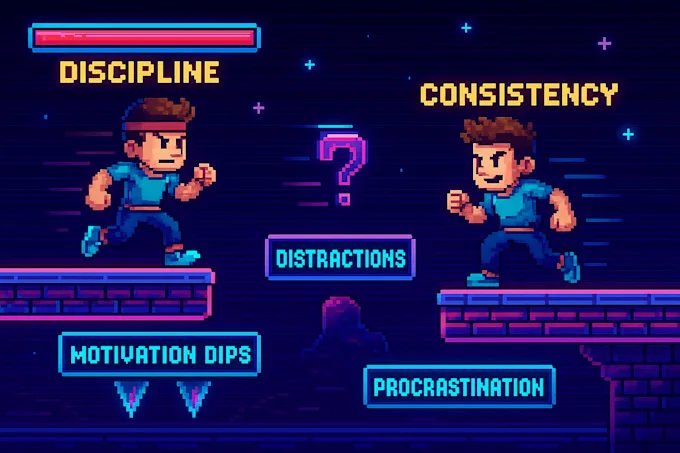
How To Build Discipline and Consistency: 7 Proven Strategies
Discipline and consistency grow through repeated, manageable actions. To build discipline and consistency, choose one behavior, decide when you will do it, remove an obstacle, and track whether you follow through. When your plan breaks down, adjust it and return at the next realistic opportunity.
You do not need to overhaul your life this week. You need a clear starting point and a routine that fits your actual circumstances.
This guide explains the difference between discipline and consistency, then walks you through seven steps you can use for studying, work, exercise, or another personal goal. You will also find a sample weekly plan and ways to restart when motivation fades.
In this guide, you'll learn:
The key difference in discipline vs. consistency, and why you need both
What research says about specific goals, if-then plans, and how long habits really take to form
7 practical steps for how to build discipline and consistency that last after motivation fades
A simple way to design your environment so the right choice becomes the easy choice
How to stay consistent when your schedule changes, and how to restart after missed days
Discipline vs. Consistency: What Is the Difference?
The simplest way to understand discipline vs. consistency: discipline is about making the right choice once, while consistency is about repeating it. Discipline is the practice of choosing actions that support your goals, even when another option feels more appealing. Consistency is repeating those actions reliably over time.
Concept | What it means | Everyday example |
Discipline | Following through on a deliberate choice despite competing impulses | Starting a planned study session instead of opening social media |
Consistency | Repeating a behavior according to a sustainable schedule | Studying on three planned evenings each week |
Motivation | The desire or energy to take action | Feeling excited about learning a new skill |
Habit | A behavior that becomes increasingly automatic in a familiar context | Opening your notebook after clearing your desk |
Discipline and consistency work together. Discipline helps you follow through today; consistency gives that effort repeated opportunities to produce results. Neither requires you to push through every obstacle or ignore your need for rest.
You can be consistent with an unhelpful behavior, just as you can make one disciplined choice without repeating it. The goal is to connect deliberate choices with useful routines.
Why Are Discipline and Consistency Important?
Learning how to build discipline and consistency matters because repeated effort creates opportunities to learn, practice, and improve. One focused session may help you understand a concept. Returning to it over several weeks gives you time to apply it, notice mistakes, and build skill.
Follow-through also makes your commitments more predictable. That matters when you are meeting work deadlines, making time for relationships, or managing your own priorities.
A realistic routine reduces the number of decisions you face each day. Instead of repeatedly asking when you will begin, you already have a plan. You still need to evaluate whether that plan is useful: consistently doing the wrong task will not bring you closer to the right goal.
7 Steps to Build Discipline and Stay Consistent
Here is how to build discipline and consistency at a glance:
Choose one specific behavior and a realistic schedule.
Attach the action to a clear cue.
Prepare your environment before you need it.
Define a smaller version for difficult days.
Track follow-through and make progress rewarding.
Add a simple accountability check-in.
Review what happened and adjust your plan.
1. Choose One Specific Behavior and a Realistic Schedule
"Be more disciplined" describes an intention. "Practice Spanish for 15 minutes after dinner on Monday, Wednesday, and Friday" describes an action.
Start with one priority. Decide what you will do, when you will do it, and how you will know you have finished. A keystone habit can eventually support several priorities, but begin with one manageable change.
For example:
Goal: Become more confident with a new skill.
Behavior: Complete one practice exercise.
Schedule: Three evenings each week.
Completion rule: Attempt the exercise and write down one thing to revisit.
Edwin Locke and Gary Latham's review of 35 years of goal-setting research found that specific, challenging goals led to higher performance than vague instructions to "do your best." Their review also explains that results depend on ability, commitment, feedback, and task complexity. It does not mean that a harder goal is always a better one.
Choose a challenge you can reasonably attempt with the time and resources available. For an unfamiliar skill, a learning goal, such as testing two ways to solve a problem, is often more useful than demanding an immediate performance result.
Try this today: Write one sentence that names your action, schedule, and completion rule. If you need help choosing a direction, work through these steps for setting goals.
2. Attach the Action to a Clear Cue
A plan becomes easier to follow when it tells you exactly when to begin. This is one of the simplest answers to how to be consistent: decide the moment in advance, so you are not relying on how you feel.
You can use a time, a place, or an existing routine as your cue:
After clearing dinner, I will open my study notes.
At 9 a.m., I will work on my first priority before checking messages.
After making coffee, I will review today's planned tasks.
Psychologists call these implementation intentions: if-then plans that connect a specific situation with a response. Peter Gollwitzer and Paschal Sheeran's meta-analysis of 94 independent tests, involving more than 8,000 participants, found that these plans had a medium-to-large effect on goal attainment. They help translate an intention into a specified action; they do not remove every obstacle.
Choose a cue that occurs reliably and leaves room for the action. Attaching a long task to the moment you usually rush out the door is unlikely to work well.
Try this today: Complete the sentence, "After I ___, I will ___." Keep the first action small enough to start immediately. Explore more examples in the habit-stacking guide.
3. Prepare Your Environment Before You Need It
Look for the small obstacles between your cue and your first action.
If studying requires finding your notes, charging your laptop, clearing the table, and deciding what to study, you have several opportunities to get sidetracked.
Prepare the essentials in advance:
Obstacle | Preparation |
You cannot find the next task | Write it at the top of your notebook |
Notifications interrupt you | Silence nonessential alerts during the session |
Your workspace is occupied | Choose a backup location |
You lose time finding materials | Leave the relevant document or book ready |
A distracting app opens automatically | Close it before your planned start |
You do not need a perfect room or an elaborate productivity setup. Change the one thing that most often delays or interrupts you.
Try this today: Spend two minutes preparing tomorrow's first action. Make the useful choice easier to reach.
4. Define a Smaller Version for Difficult Days
An ambitious routine can work on a quiet day and fail when your schedule changes. Decide in advance what a reduced version looks like.
Planned action | Smaller version |
Study for 25 minutes | Review one concept for five minutes |
Write a full article section | Draft three useful bullet points |
Organize the entire desk | Clear the area needed for the next task |
Review a monthly budget | Categorize one recent transaction |
The smaller version should still connect to your goal. Its purpose is to keep a useful action available when the original plan is impractical. It is also how to stay consistent without burning out: you protect the routine without forcing a full session on a bad day.
It is not a requirement to perform every habit every day. Rest, illness, emergencies, and changing priorities may call for a pause. A sustainable plan makes room for those realities.
Try this today: Write a normal version and a smaller version of your chosen behavior. Decide when the smaller version is appropriate.
5. Track Follow-Through and Make Progress Rewarding
Record what you actually did. A calendar, notebook, or weekly habit tracker is enough.
Tracking is also how to stay consistent without guessing: you can see what actually happened. Use a simple mark for a full session, a smaller session, or a planned rest day. If you miss a session, note the main obstacle without turning the record into a judgment of your character.
Track the behavior you control. For studying, that might mean completed practice sessions and questions attempted. A test score is useful feedback, but it is not the only sign that you followed the plan.
You can also experiment with a small game:
One point for starting at the planned cue.
One additional point for completing the planned action.
One point for a thoughtful weekly review.
Choose a modest reward that fits your goal and circumstances. This is an illustrative system, not a scientifically prescribed scoring formula. If points become distracting, simplify them.
Moore Momentum's approach to gamifying your life offers another way to make the process engaging. The game should support the behavior, rather than become a new task to manage.
Try this today: Choose one place to record your next three planned sessions.
6. Add a Simple Accountability Check-In
Sharing your plan with someone else is a practical way to learn how to be consistent. Accountability is more useful when the other person knows what you committed to and what kind of support you want.
Ask a friend, colleague, or study partner for a short weekly check-in. Share:
What you planned.
What you completed.
The obstacle you encountered.
What you will change next.
For example, a student might report that they completed two of three planned sessions and found Friday evenings unreliable. Their next step could be moving that session to Saturday morning.
Choose someone who helps you think clearly. You do not need a person who monitors every choice or makes missed sessions feel embarrassing.
If you prefer working alone, schedule the same review with yourself. Answer the questions in writing so that your next plan reflects what actually happened.
Try this today: Set a five-minute review appointment. Decide whether it will be individual or shared.
7. Review What Happened and Adjust Your Plan
Consistency includes learning how to repeat the behavior under real conditions. If you want to know how to stay consistent over months rather than days, this weekly review is where it happens.
At the end of the week, ask:
Which sessions were easiest to start?
What got in the way of the others?
What single change would make next week more workable?
Perhaps your goal was too large. Perhaps the cue was unreliable. Perhaps the task was unclear, or the schedule competed with something more important.
Treat these as different problems. A reminder helps with forgetting, but it will not solve a routine that requires more time than you have.
Keep what worked and change one element. Give the revised plan a fair trial before adding more complexity. This creates a feedback loop between your plan and your experience.
Try this today: Choose one adjustment based on evidence from your week, rather than making a completely new plan.
How to Be Disciplined and Consistent in Studies
If you are working out how to build discipline and consistency as a student, start here. Studying benefits from a clear task, a manageable session, and a way to check understanding.
Before you begin, decide what you will practice. "Study chemistry" leaves many decisions open. "Attempt five questions on balancing equations and review the mistakes" gives the session direction.
Use a routine like this:
Start after a reliable cue, such as clearing dinner.
Put distracting devices out of immediate reach.
Open the exercise selected in advance.
Work for the planned period.
Record what you understood and what needs another attempt.
Leave the next task ready.
A completed session does not have to feel impressive. What matters is that it gives you useful practice and information for the next session.
The same structure works for professional learning: choose one exercise, apply the skill, identify a gap, and return to it.
A Sample Weekly Plan for Building Consistency
The following is an illustrative learning routine that shows how to build discipline and consistency in an ordinary week. Adapt the timing and frequency to your own responsibilities.
Day | Plan | Completion rule |
Monday | Practice after dinner for 20 minutes | Attempt one exercise |
Tuesday | Planned break | No session required |
Wednesday | Practice after dinner for 20 minutes | Revisit Monday's mistake and try another exercise |
Thursday | Prepare materials | Choose the next exercise |
Friday | Practice after dinner for 20 minutes | Attempt the exercise and note one question |
Saturday | Optional catch-up or rest | Decide according to available time and energy |
Sunday | Five-minute review | Record what worked and choose one adjustment |
If a planned session becomes impractical, use the five-minute version or reschedule it. Record what happened so that the next week's plan is more realistic.
How to Stay Disciplined When Motivation Fades
When you do not feel like starting, check the task before criticizing yourself. Knowing how to be consistent on low-energy days usually comes down to the size and clarity of the first step.
Is the first action clear? Is it too large? Are the materials ready? Is this still a realistic time?
Try starting with the smaller version you already defined. After a few minutes, decide whether continuing makes sense. Sometimes beginning is the main obstacle; sometimes tiredness or competing responsibilities require a different plan.
The distinction between motivation and discipline can help you understand the challenge, but you do not need to eliminate motivation from the process. Interest, enjoyment, support, and a meaningful goal are all useful. Learning how to be disciplined is less about forcing yourself and more about making the next action clear and easy to start.
What to Do After Missing Several Days
Return to the next manageable action. Avoid making the restart so demanding that it becomes another reason to delay.
Identify the cause, adjust the plan, and choose a specific return point. Work on reducing self-judgment so that a missed session remains a problem you can solve, rather than a label you apply to yourself. If your old schedule repeatedly failed, restarting the same schedule without changes is unlikely to solve the problem.
A rule such as "never miss twice" can be a personal reminder, but it is not a universal definition of consistency. Focus on returning in a way that fits your circumstances.
Conclusion: How to Build Discipline and Consistency
If there's one thing I've learned from building businesses and obsessing over habits for the last 25 years, it's this: discipline and consistency aren't personality traits you're born with; they're muscles you build. I've had days where I felt like I was crushing it and years where I felt like I was spinning my wheels. Looking back, the difference-maker was never a sudden burst of "willpower." It was the systems I put in place. When I stopped relying on how I felt and started relying on my routine, that's when the "magic" happened. It's how I managed to keep my head above water during the Bite Squad merger and eventually hit that $320M exit.
You don't need to change your entire life by tomorrow morning. You just need to win the next two minutes. Build your habit stack, fix your environment, and give yourself the grace to be human when things get messy. The goal isn't to be perfect; it's to keep the momentum moving forward.
The only question left is: which of the 5 Core Areas of Life are you going to start with today?
🚀 Ready to Make Discipline Feel Effortless Instead of Exhausting?
You just learned how to build discipline and consistency with science-backed steps. But here's what most people miss: these strategies work even better when they're part of a complete system that makes staying disciplined feel like playing a game instead of grinding through willpower.
👉 Take the Core Values Quiz to discover exactly where your discipline is breaking down, and get your personalized roadmap to fix it across all 5 Core Areas and live a balanced and fulfilling life.
In under 60 seconds, you'll uncover your Momentum Score, identify the hidden friction points sabotaging your consistency, and unlock the Moore Momentum System: the AI-powered platform that transforms the discipline strategies you just learned into an engaging, rewarding adventure. No more relying on motivation or beating yourself up when you slip. Just science-backed habits, gamified tracking, and a system that evolves with you.
Start Building Unstoppable Discipline NOW!
🚀🚀🚀 Don't forget to check out our RESOURCE ARCADE 👾🎮 for FREE templates and tools to gamify your habits.

FAQs About How to Be Disciplined and Consistent
How Do You Stay Consistent?
To stay consistent, attach one small action to an existing routine so it starts automatically, and decide a smaller version for busy days. Track what you complete, not a perfect streak. When you slip, return at the next realistic opportunity. Consistency isn't perfection; it's reliably coming back.
How Do You Become Disciplined in Life?
Build discipline through small, specific actions rather than dramatic changes. Set clear rules for yourself, remove temptations from your environment, and track your progress. When you slip, adjust the plan without self-judgment. Connect your habits to your deeper values, use a friend or mentor for accountability, and rely on systems that make good choices automatic.
How Long Does It Take to Build Discipline and Consistency?
In UCL's habit-formation study, led by Phillippa Lally, a new daily behavior took a median of 66 days to become automatic, with individual results ranging from 18 to 254 days. The popular 21-day rule is not a reliable promise.
Building discipline and consistency across several areas of life takes longer than forming one habit. Measure whether your chosen behavior is becoming easier to start and more reliable over time, and adjust the task and setting when progress stalls.
How Do I Build Consistency if My Schedule Changes Every Week?
Use a flexible cue, such as finishing breakfast or arriving home, and plan sessions around your actual week. Decide your smaller version in advance. A routine can be consistent without happening at the same clock time every day. That is how to stay consistent when your week is unpredictable.
Can I Be Disciplined Without Feeling Motivated?
Yes. You can follow a plan even when enthusiasm is low. Make the first action specific, reduce avoidable distractions, and use a manageable starting point. You do not have to feel equally motivated at every session.
Discipline vs. Consistency: Which Matters More?
Neither wins on its own. In the discipline vs. consistency debate, they serve related purposes. Discipline helps you make a useful choice; consistency helps you repeat it. Focus on choosing a worthwhile behavior and making regular follow-through feasible, rather than trying to maximize one quality in isolation.
How Do You Maintain Discipline in Daily Life?
Start with a clear goal and a simple routine you can repeat. Break big tasks into small steps and link each one to a reliable cue. Remove distractions before they tempt you, track your progress, and reward small wins. When you slip, restart without guilt. Over time, routines replace willpower and discipline feels automatic.
How Can I Improve Consistency Without Burning Out?
Match the routine to your capacity. Limit the number of new commitments, include recovery time, and review whether the schedule is realistic. Increase the challenge when the current version is manageable, rather than expanding it after one unusually productive day.
What Is the Best Way to Become More Self-Disciplined?
Start with the obstacle that repeatedly stops you. If you forget, strengthen the cue. If the task feels overwhelming, reduce its size. If you are distracted, change the environment. Practice one workable routine and use feedback to improve it.


Founder & CEO of Moore Momentum
Will Moore is a serial entrepreneur, life coach, and habit science expert with a $300M+ exit under his belt. After hitting suicidal rock-bottom as a teen, he dedicated his life to cracking the code on lasting happiness and success — and built Moore Momentum to share what he found.
He helps people discover WHO they are, WHAT they really want, and HOW to get there by combining proven principles, science, AI, and gamification.
His mission: make growth ethically addictive and inevitable.