





Keystone Habits: Improve Your Life with Simple Changes
Life can be funny sometimes. I remember being a tall, skinny high school sophomore, 6’3” and barely 145 pounds, just hoping for a growth spurt to catch up with the other guys. When it finally happened, my body and brain seemed to be on different pages. I was always tripping over myself, knocking things over in the lunchroom, and feeling like a real-life “Diary of a Wimpy Kid” before that was even a thing.
But here’s the surprising part - those awkward times led me to discover something powerful: the impact of small, consistent changes. It all started when I began reading self-help books, determined to reinvent myself. Without knowing it, I stumbled upon what we now call “keystone habits” - simple actions that trigger a chain reaction of positive changes in your life.
Fast-forward. This journey of self-discovery and personal growth eventually led me to become a serial entrepreneur, with my biggest success coming from a Food Delivery startup that my partners and I exited for $321 million. How did it happen? In this article, we’ll explore these key habits and how they can transform your life, just like they did mine.
Keystone habits are single behaviors that trigger a chain reaction of positive change across unrelated areas of your life. Coined by Pulitzer Prize-winning journalist Charles Duhigg in The Power of Habit, they work by creating small wins, shifting your identity, and building the momentum that makes your next good habit dramatically easier to keep.
Upgrades You'll Earn from This Blog
Improved Physical and Mental Health
Enhanced Productivity and Professional Growth
Strengthened Personal and Professional Relationships
Increased Self-Confidence and Self-Efficacy
Better Financial Management
Enhanced Creativity and Problem-Solving Skills
Keystone habits can change your life by initiating a ripple effect of beneficial changes.

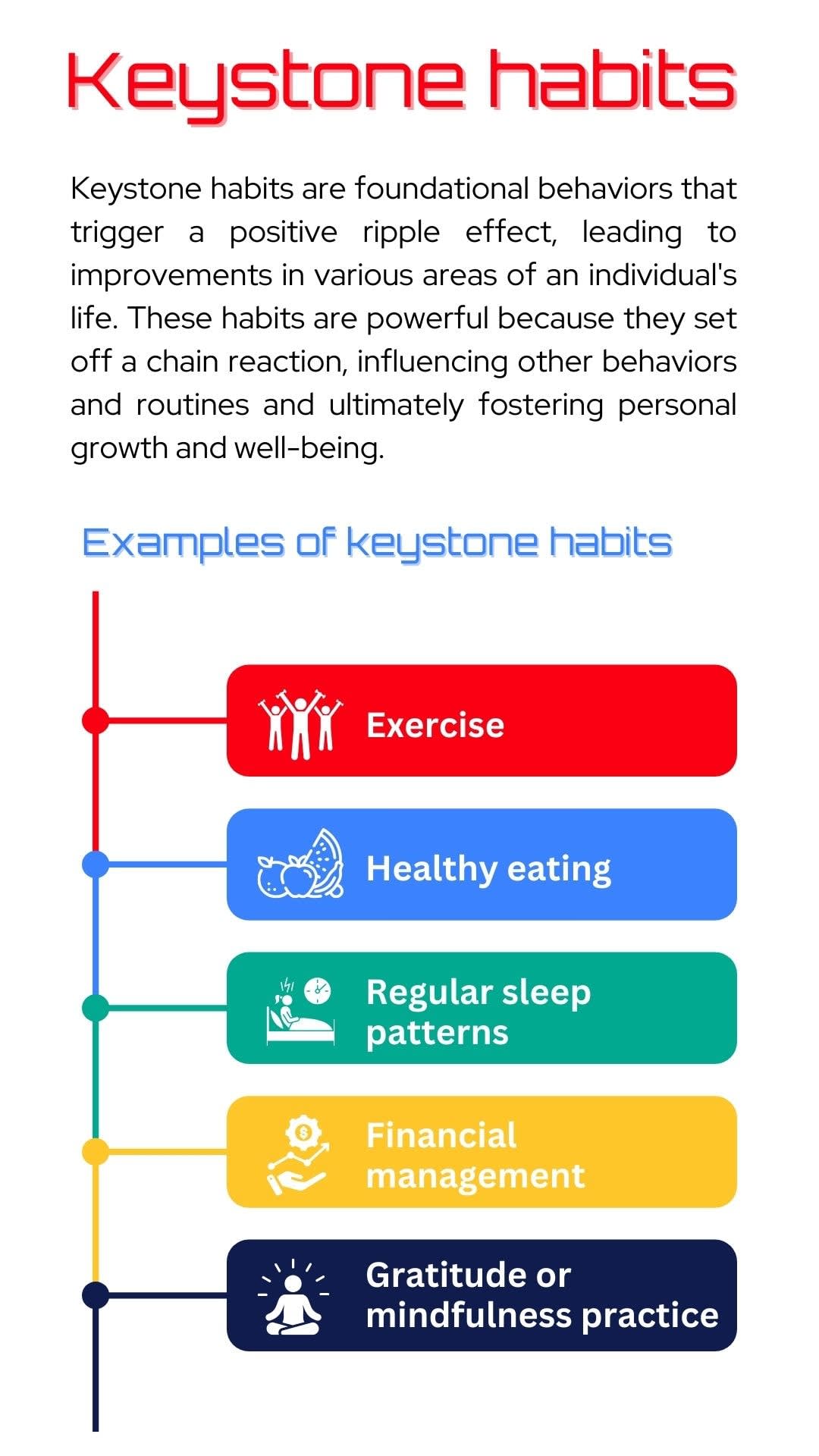
What Are Keystone Habits?
The term comes from Charles Duhigg, the Pulitzer Prize-winning New York Times reporter who introduced it in his 2012 book The Power of Habit. Duhigg's argument was simple but counterintuitive: not all habits carry equal weight. A small number of them sit at the base of everything else and quietly reorganize the habits stacked on top of them.
That is what separates a keystone habit from an ordinary one. An ordinary habit improves the thing it touches. A keystone habit works like the domino effect of one tiny habit, where the first one falling knocks over everything behind it.
Here’s what makes keystone habits special:
They start a chain reaction of good changes.
They help us improve in many areas, not just one.
They’re usually simple to do but have big effects.
Let’s understand it with an example: when someone starts working out regularly, they often start eating healthier, too. They might sleep better and feel more energetic. This can make them do better at work and handle stress more easily.
How Keystone Habits Shaped My Life
The power of keystone habits extends far beyond physical fitness. In college, when I discovered the book "How to Win Friends and Influence People," it sparked a passion for self-improvement that has shaped my entire life trajectory. This habit of continuous learning and personal development became a keystone that opened doors in my career, relationships, and overall life satisfaction. Along the way, I've developed a unique gamified system to help people build success habits and become entrepreneurs of the most important business they'll ever run—their lives.
Another pivotal keystone habit in my life was learning to manage my ADHD by focusing on the most important tasks using the Pareto Principle. This not only improved my productivity but also reduced stress and increased my sense of accomplishment in various areas of life.
“Motivation is what gets you started. Habit is what keeps you going.” - Jim Ryun
The cool thing about keystone habits is that you don’t have to change everything in your life at once. By focusing on one or two of these special habits, you can see improvements in all areas of your life. It’s like planting a small seed that grows into a big, healthy tree with many branches.
Read More: 10 Habits of Successful People
Characteristics of Keystone Habits
Ripple Effect: Keystone habits trigger positive changes across different areas of life, producing improvements in aspects that seem entirely unrelated.
Small Wins: They deliver quick successes that build confidence and generate momentum for forming additional positive habits.
Identity Shift: Engaging in identity-based habits changes how you see yourself, such as thinking of yourself as a healthy person after months of consistent exercise. During my college years I went from a skinny teenager to gaining 45 pounds of muscle. That physical change shifted my self-perception from awkward outsider to someone capable.
Skill Development: These behaviors build transferable skills, like time management, that lift both personal and professional performance.
Increased Self-Discipline: Consistently practicing one strengthens self-discipline, which makes adopting the next good habit measurably easier.
Spillover Effect: The positive emotions and energy they generate lift your overall mood and outlook.
Mechanisms of Keystone Habits
Building keystone habits is a foundational strategy for implementing behavioral change. It makes these habits easy and integrates them into daily routines. By understanding the underlying mechanisms, you can more effectively develop and maintain these habits, leading to sustained personal growth and improved overall well-being.
1. Neuroplasticity
Repeating a behavior physically changes your brain. The neural pathways tied to that action strengthen with use, which is why something that felt effortful in week one runs on autopilot by week ten.
Meditation gives us the clearest picture of this. A team led by Britta Hölzel and Sara Lazar at Massachusetts General Hospital and Harvard Medical School scanned 16 meditation-naive participants before and after an eight-week mindfulness program. The post-scans showed measurable increases in grey matter concentration in regions tied to learning, memory, and emotional regulation. Eight weeks. Not eight years.
One honest note on scale: 16 people is a small sample, and later research has refined the picture. But the direction of the finding is consistent across the literature, and the practical takeaway holds. Repetition reshapes the hardware.
2. Cognitive Bandwidth
Every decision you make costs something. Automating a behavior stops charging you for it.
Wendy Wood, Provost Professor Emerita of Psychology and Business at the University of Southern California, spent three decades measuring exactly this. Her research found that roughly 43 percent of what people do on a given day is repeated in the same context while they are thinking about something else entirely. Nearly half your day is already running without conscious input.
That number cuts both ways. It explains why bad patterns are so stubborn, and it explains why a well-placed good one pays out every single day without asking for willpower. Turn meal prep into an automatic Sunday behavior and you stop spending mental energy on it Monday through Friday. That reclaimed bandwidth goes somewhere. Usually toward whatever you have been too depleted to start.
3. Compound Effect
Small consistent actions accumulate into results a single burst of effort cannot match. Save a modest amount daily and you end the year with something meaningful. Read ten pages a night and you finish roughly fifteen books.
The automaticity curve compounds the same way, and researchers have mapped its shape. Phillippa Lally and her team at University College London tracked 96 volunteers building a new daily behavior over 12 weeks, measuring how automatic it felt each day. The pattern that emerged: early repetitions produce the largest gains in automaticity, then returns taper toward a plateau. Consistency of repetition was the strongest predictor of whether the behavior locked in at all.
Translation: the first few weeks are doing the heaviest lifting. That is also precisely when quitting feels most reasonable.
4. Positive Feedback Loops
Keystone habits often create positive feedback loops. The benefits you experience from the habit motivate you to continue the behavior, which in turn leads to more benefits. For example, regular exercise can improve your mood and energy levels, which in turn makes you more likely to continue exercising, reinforcing the habit.
The Alcoa Story: How One Habit Reorganized an Entire Company
In 1987, Alcoa named Paul O'Neill chief executive. Wall Street analysts packed the room expecting the usual: margins, market share, earnings forecasts. O'Neill opened by pointing out the emergency exits. Then he announced he wanted to talk about worker safety, and that his target was zero injuries.
The room nearly emptied. One investor told Duhigg he went straight to a lobby phone and told his largest clients to dump the stock. He later described it as the worst advice he gave in his entire career.
Here is why he was wrong. O'Neill was not being sentimental. He had worked out that you cannot order a hundred thousand people to change, so he picked the one behavior that touched every other system in the company. To eliminate injuries, Alcoa had to understand precisely why each one happened. That meant repairing broken processes, closing the communication gap between the factory floor and the executive suite, and giving frontline workers the authority to flag problems without waiting for permission.
Safety was the entry point. Operational discipline was what actually spread.
The results, revisited by Forbes decades later: lost workdays from injury fell from 1.86 per 100 workers to 0.2. Profits hit a record within a year. By the time O'Neill retired in 2000, Alcoa's annual net income was five times what it had been when he arrived, and its market capitalization had risen by $27 billion.
O'Neill never tried to change a hundred habits. He changed one, and let the ripple effect handle the rest.
One honest caveat before you run with this. Duhigg's account is a narrative case study, not a controlled experiment, and Alcoa's turnaround had other contributing factors. What the story demonstrates reliably is the mechanism, not a guaranteed outcome. The same logic applies to your own life: picking one foundational behavior is a smarter bet than overhauling ten at once, but it is a bet, not a formula.
Keystone Habits Examples in the Five Core Areas of Life
Developing keystone habits can create a ripple effect of positive changes across multiple areas of your life. In my journey from rock bottom to success, I've discovered that true fulfillment comes from nurturing and balancing five pillars of life: Mindset, Career & Finances, Relationships, Physical Health, and Emotional & Mental Health. Striving for balance across these five cores isn't just about personal satisfaction - it's about becoming the best version of yourself and creating a ripple effect of positive change in the world. When you fire on all cylinders in these areas, you're not just living - you're thriving.

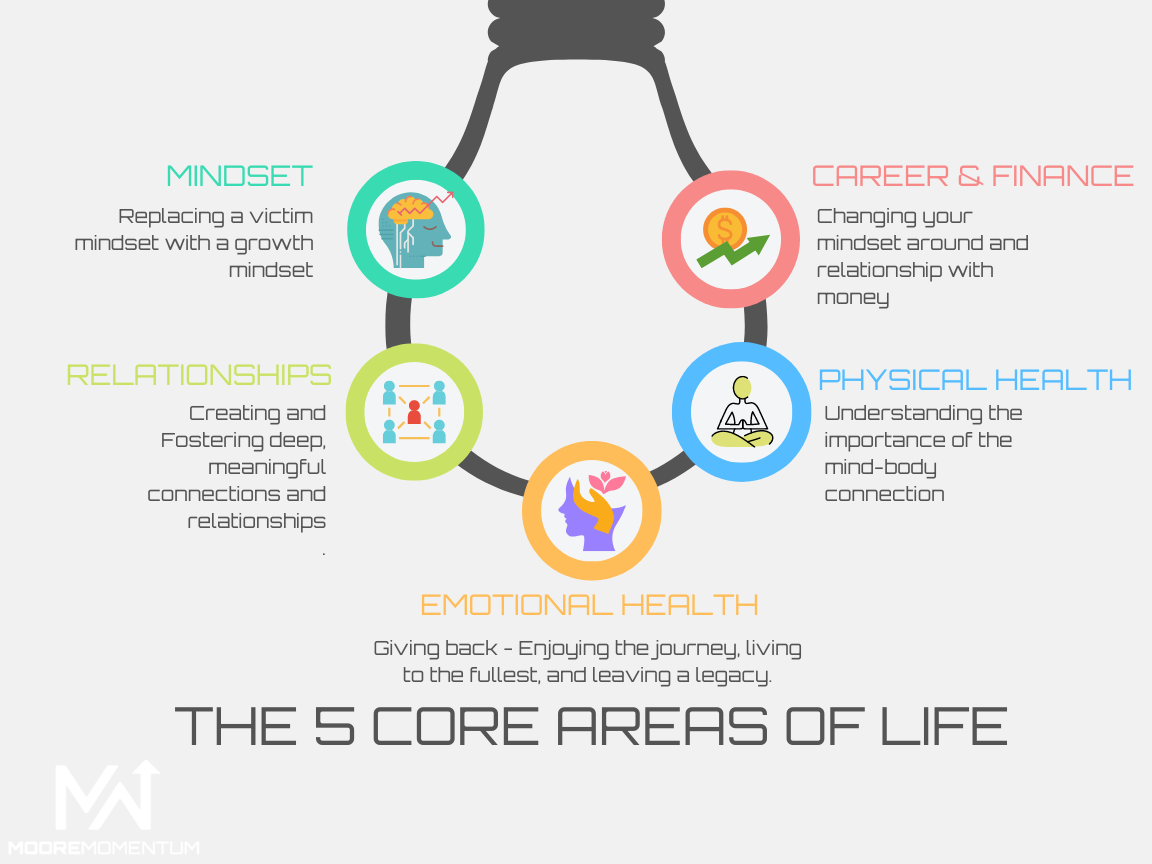
As you develop keystone habits in each core, you'll find they often overlap and reinforce each other, creating an upward spiral of positive change. Below are some examples of keystone habits that can significantly impact your core areas in life:
1. Mindset Core
Practicing Gratitude or Mindfulness
Regular gratitude or mindfulness practices can significantly impact your overall mindset and mental well-being. Start with just 5 minutes a day of meditation, or write down three things you're grateful for. These practices can trigger:
Improved mental health and reduced anxiety
Increased resilience in the face of challenges
Enhanced self-awareness and personal growth
Better sleep quality
Improved focus and decision-making abilities
Continuous Learning and Skill Development
Cultivating a habit of lifelong learning keeps your mind sharp and adaptable. Dedicate 30 minutes a day to learning something new. This can lead to:
Enhanced problem-solving and critical thinking skills
Improved adaptability in a changing environment
Greater confidence and self-efficacy
Potential for innovation and creativity in your personal and professional life
Increased overall life satisfaction and purpose
2. Career & Finances Core
Financial Management (e.g., Budgeting)
Implementing basic financial habits like tracking expenses or setting a budget to reduce impulse buying can transform your financial health. Start by recording all expenses for a month to understand your spending patterns. This can lead to:
Reduced financial stress
Improved decision-making in other areas of life
Increased long-term planning and goal-setting skills
Better relationship dynamics (especially for couples)
Enhanced sense of control and self-efficacy
Time Management and Productivity Habits
Implementing effective time management techniques, such as the Pomodoro Technique or time-blocking, can revolutionize your workday. Start by breaking your day into 25-minute focused work sessions with short breaks in between. This can lead to:
Increased productivity and output
Reduced work-related stress
Improved work-life balance
Enhanced reputation and career advancement opportunities
Better habit formation in other areas of life
Read More: How Many Hours Does It Actually Take To Master Something?
3. Relationships Core
Networking and Relationship-Building
Making a habit of regular networking or relationship-building activities can boost both your personal and professional life. Set a goal to reach out to one new contact or strengthen an existing relationship each week. This can result in:
Increased personal and career opportunities
Enhanced learning and skill development through knowledge sharing
Improved communication skills
Greater life satisfaction and engagement
Potential for mentorship and guidance
Effective Communication Habits
Developing habits around clear and regular communication, such as active listening or providing constructive feedback, can transform your relationships. Practice summarizing what others say before responding. This can lead to:
Improved personal and professional relationships
Reduced conflicts and misunderstandings
Enhanced leadership skills
Increased trust and respect from others
Better overall social connections and support network
Read More: Keeping Score in Relationships
4. Physical Health Core
Regular Exercise
Exercise is often cited as one of the most powerful keystone habits. It doesn't have to be intense - even a 20-minute walk or a short yoga session can make a difference. The key is consistency. When people start exercising regularly, they often experience a cascade of positive changes:
Improved sleep quality
Better dietary choices
Increased energy and productivity
Enhanced mood and reduced stress
Improved self-image and confidence
Healthy Eating Habits
Adopting healthier eating habits, such as meal planning or increasing vegetable intake, can have far-reaching effects. Start small, like adding one serving of vegetables to each meal or drinking water instead of sugary drinks. These changes can lead to:
Better overall nutrition
Improved energy levels
Enhanced cognitive function
Better financial management (through reduced eating out)
Increased cooking skills and creativity
Read More: How to Get Back on Track with Diet
5. Emotional & Mental Health Core
Regular Sleep Patterns
Establishing a consistent sleep schedule is crucial for overall emotional and mental health. Aim for 7-9 hours of sleep per night and try to go to bed and wake up at the same time each day, even on weekends. This can result in:
Improved cognitive function and memory
Better emotional regulation
Enhanced physical health and immune function
Increased productivity and focus during waking hours
Reduced risk of mental health issues
Regular Goal-Setting and Review
Establishing a habit of setting and reviewing goals can drive your personal growth and emotional well-being forward. Set aside time each week to review your progress and adjust your goals as needed. This can result in:
Clearer direction and purpose in life
Improved decision-making aligned with long-term objectives
Increased motivation and engagement
Better time management and prioritization
Enhanced ability to track and celebrate progress, boosting self-esteem
Keystone Habits List
Here’s how you can identify and implement keystone habits in your life:
Self-Assessment Techniques:
Reflect on your current routines and behaviors. Which ones seem to have a positive ripple effect on other areas of your life?
Consider your long-term goals. What daily habits might contribute to achieving these goals?
Think about times in your life when you’ve experienced positive change. What behaviors or habits were you engaging in during those periods?
Goal Setting and Alignment with Core Values:
Identify your core values and life priorities. What habits align with these values?
Set SMART (Specific, Measurable, Achievable, Relevant, Time-bound) goals for different areas of your life. Example: If your core value is health, a SMART goal could be: “I will exercise for 30 minutes, five days a week for the next three months to improve my cardiovascular health.”
Consider which habits might serve as stepping stones towards these goals.
Create a Personalized Keystone Habits List:
Based on your self-assessment and goal-setting, create a list of potential keystone habits.
Prioritize this list based on which habits you believe will have the most significant impact.
Start with one or two habits that feel most achievable and aligned with your current lifestyle and goals.
Integrate new habits into your daily routines by planning, tracking progress, and using tools to maintain motivation.
Examples of Keystone Habits List
Focusing on just one keystone habit can create a domino effect, leading to improvements in productivity, personal relationships, and emotional well-being.
Daily Personal Keystone Habits:
Wake up at 6:00 AM every day
10-minute meditation session upon waking
Drink a glass of water before breakfast
30 minutes of exercise (alternating between cardio and strength training)
Read for 20 minutes before bed
Weekly and Monthly Keystone Habits:
Sunday meal prep for the week ahead
Weekly budget review and financial planning session
Monthly goal-setting and progress review
Attend one networking event or professional development workshop per month
Long-term Keystone Habits for Life Transformation:
Cultivate a growth mindset through daily affirmations and journaling
Practice active listening in all conversations
Continuously learn by taking one online course per quarter
Volunteer for a cause you care about once per month
How to Develop and Maintain Keystone Habits
Knowing which behavior to build is half the job. Getting it to survive contact with a real week is the other half. The six steps below are ordered deliberately. Each removes a different kind of friction, and skipping ahead is the most common reason habit formation stalls out.
1. Start Ridiculously Small
Begin with powerful micro habits, actions so small they feel almost too easy to skip. If the goal is to read more, start with one page a night. If it's exercise, start with putting the shoes on.
This feels like cheating. It isn't. Remember what the Lally curve showed: early repetitions produce the largest gains in automaticity. What you're buying with a one-page commitment is the repetition, not the page. Size can grow later. Consistency cannot be added retroactively.
Starting small also protects you from the failure mode that takes out most ambitious people, which is overhauling five areas at once and quitting all five by week three. If you're already running on empty, learn to prevent burnout before it starts before adding anything new to the pile.
2. Make It Obvious
Wendy Wood's 43 percent figure isn't just an interesting statistic. It's an instruction. If nearly half your day is cued by context, the fastest way to install a behavior is to change the context rather than to try harder.
Put the thing where you'll trip over it. Gym clothes on the floor beside the bed. Journal on the pillow. Water bottle on the desk before you sit down.
Then anchor the new behavior to something you already do without thinking. After I pour my coffee, I write three lines. The cue does the remembering so you don't have to.
3. Make It Easy
Count the steps between you and the behavior, then delete some.
If the gym is a 30-minute drive, you will eventually stop going. If your running shoes sit in a closet behind a suitcase, that suitcase is your real obstacle. Reduce the decisions, the objects to locate, and the minutes required before the habit actually begins. Habit bundling helps here, because attaching a new behavior to an existing routine means you inherit a slot in your day instead of having to invent one.
Then run the same logic in reverse on whatever you're replacing. Delete the app. Move the snacks upstairs. Add friction to what you don't want, subtract it from what you do.
4. Make It Fun and Rewarding
This is the step almost everyone skips, and it's the one that decides whether the habit survives past the motivation window.
Your brain repeats what felt good, not what was virtuous. So build the payoff in on purpose. Duhigg's original loop was cue, routine, reward. James Clear later expanded it to cue, craving, response, reward. Either version makes the same point: the reward isn't decoration, it's the mechanism.
Give yourself something immediate and real. The podcast you only allow during the walk. A box you genuinely enjoy ticking. A text to the friend tracking alongside you. If the habit produces nothing but self-approval, it's competing against every dopamine-rich distraction you own, and it will lose that fight.
5. Track It Somewhere You Can See It
Use a habit tracker to make progress visible. A "don't break the chain" calendar works because the growing streak becomes its own reward.
Set milestones and attach a real celebration to each one. Seven days. Thirty days. Ninety. Small wins compound faster when you actually acknowledge them.
6. Plan for the Miss Before It Happens
You will miss days. Build for that now, while you're calm, instead of improvising in the moment you're already discouraged.
Anticipate the specific disruptions. If travel breaks the routine, design a travel version in advance. If a brutal week is coming, decide now what the two-minute version looks like.
Then use the 2-Day Rule. Never skip the habit two days in a row. Miss a journaling session? Fine. Just make sure the next night happens, no matter what. This maps directly onto what the UCL researchers found: consistency of repetition, not perfection, is what determines whether a behavior becomes automatic. One missed day is noise. Two in a row starts rebuilding the old pattern.
Learn More About: How to Manifest Something
What Keystone Habits Can't Do
Everything above works. It just doesn't work the same way for everyone, and you deserve to know where the edges are before you build your whole plan on this idea.
The evidence is more suggestive than conclusive
The Alcoa story is compelling, but it's a case study, not a controlled trial. Duhigg's book popularized a real pattern that behavioral researchers had been circling for years, and the underlying components hold up well: context cues drive automatic behavior, repetition builds automaticity, and small wins reinforce motivation. Each of those has solid research behind it.
What has not been established is that any specific habit is reliably keystone for everyone who tries it. Exercise cascades into better eating for a lot of people. For plenty of others it produces nothing but sore legs and a bigger appetite. The mechanism is real. The universality is marketing.
The same habit isn't keystone for everyone
A keystone habit works by relieving a bottleneck that's actually blocking you. Which means the right one is entirely dependent on where your bottleneck sits.
If your central problem is that you're chronically underslept, a 5am workout is not a keystone habit. It's a second problem stacked on the first. If your finances are the thing quietly eating your attention all day, meditation will not touch it. Copying someone else's keystone habit is one of the most common ways people spend six months building the wrong thing well.
One habit won't fix a structural problem
This is the caveat that matters most, and it's the one you'll almost never see in an article like this.
Habits operate at the level of individual behavior. Some problems don't live there. If you're in an unsafe home, working a job that's genuinely making you ill, carrying untreated depression or anxiety, or facing real financial precarity, a morning routine is not the intervention. Framing structural or clinical problems as habit problems shifts blame onto the person carrying them, and that framing does real harm.
Behavior change is a powerful lever when the thing in your way is behavioral. When it isn't, the honest answer is that you need a different kind of help, and reaching for it is not a failure of discipline. If any of that describes your situation, talking to a doctor, therapist, or another qualified professional is the more useful next step.
It's slower than it looks
The transformation stories compress years into paragraphs. Lally's data found a median of 66 days for a single behavior to reach automaticity, and a range stretching to 254 days. That's one habit.
The ripple across other areas comes after that, not during it. Plan for months, and treat anything faster as a bonus rather than the baseline.
Conclusion:
I still think about that 6'3", 145-pound sophomore knocking things over in the lunchroom.
What eventually turned it around wasn't a personality transplant or some burst of discipline I'd been missing. It was one habit. I started reading. That's it. Reading led to lifting, lifting led to a body I recognized, and recognizing myself led to walking into rooms differently. Nobody handed me a five-part plan. One domino fell and took the rest with it.
That's the entire idea, and it's why this works when so much else doesn't. You are not required to fix your mindset, your money, your relationships, your body, and your mental health simultaneously. That project has never worked for anyone, including the people selling it.
Pick one. Make it small enough that skipping it feels absurd. Make the cue obvious, the action easy, and the payoff something you actually want. Then protect it for a couple of months while it becomes automatic, and let the ripple do the work you were about to try doing manually.
Some caution is warranted. It'll take longer than the transformation stories suggest, the right habit for you probably isn't the one that worked for your friend, and if what's really in your way is structural rather than behavioral, this isn't the tool for that job.
But if you're just stuck? If you know roughly what you should be doing and cannot seem to build any traction?
One domino. That's genuinely where it starts.
🚀 FIND THE ONE HABIT THAT MOVES EVERYTHING ELSE
You now know what a keystone habit is and how to build one. The part this article can't answer is which one is yours, because that depends entirely on where your bottleneck actually sits.
👉 Take the Core Values Quiz and get your Personalized Momentum Score across all 5 Core Areas in under 60 seconds. It's the same starting point we use inside the Moore Momentum System, the AI-powered, science-backed, gamified engine that every strategy in this article came from.
You'll walk away knowing:
Which Core is quietly draining the other four
Where your biggest friction point is hiding
Which single habit gives you the fastest ripple
🚀🚀🚀 Don't forget to check out our RESOURCE ARCADE 👾🎮 for FREE templates and tools to gamify your habits.

FAQs on Keystone Habits
What is a keystone habit?
A keystone habit is a single behavior that sets off a chain reaction of change across unrelated parts of your life. Charles Duhigg introduced the term in The Power of Habit. Exercise is the classic case: people who start working out consistently tend to eat better, sleep better, and procrastinate less, without ever deliberately deciding to.
What are some keystone habits examples?
The most reliable keystone habits examples are regular exercise, consistent sleep and wake times, a short daily planning or goal review, meal preparation, and a brief journaling or gratitude practice. Each is small enough to sustain and connected enough to spill into your energy, focus, mood, and relationships. Start with one, not five.
How do I identify my keystone habits?
Look backward first. Think of a stretch when several areas of your life were going well at once, then ask what you were doing consistently during that period. That is usually your keystone habit hiding in plain sight. Then check it against your core values and your single biggest current frustration. The right one relieves a real problem, not a hypothetical one.
What is the difference between a keystone habit and an atomic habit?
An atomic habit, a term from James Clear, describes scale: a behavior small enough to be nearly frictionless. A keystone habit describes leverage: a behavior whose effects spread outward into other areas. They are not competing ideas. The best habit to build is both, small enough to start today and connected enough to matter. Read our article on Atomic Habits Quotes
How can I create a keystone habit?
Anchor it to something you already do every day, so the cue is built in rather than remembered. Shrink the first version until it feels almost too easy to skip. Attach something you genuinely enjoy to the moment right after. Then track it somewhere visible. Cue, ease, and reward are the three levers, and most people fail because they only pull the first one.
How long does it take to build a keystone habit?
Not 21 days. That number traces back to a 1960 observation about plastic surgery patients, not to habit research. The actual study, run by Phillippa Lally's team at University College London, found a median of 66 days to reach peak automaticity, with a range spanning 18 to 254 days depending on the person and the behavior. Here is the fuller breakdown of why it isn't actually 21 days.
Can keystone habits change over time?
Yes, and they should. A behavior that was keystone at 25 with no kids may be irrelevant at 35 with two. Reassess every few months by asking one question: is this still creating spillover into other areas? When it stops rippling, it has quietly become a maintenance habit, and it is time to pick a new lever.


Founder & CEO of Moore Momentum
Will Moore is a serial entrepreneur, life coach, and habit science expert with a $300M+ exit under his belt. After hitting suicidal rock-bottom as a teen, he dedicated his life to cracking the code on lasting happiness and success — and built Moore Momentum to share what he found.
He helps people discover WHO they are, WHAT they really want, and HOW to get there by combining proven principles, science, AI, and gamification.
His mission: make growth ethically addictive and inevitable.