




The 3 Types of Empathy: What They Are and How to Build Them
There's a moment most of us have experienced but rarely talk about. Someone close to you — a partner, a friend, a coworker is clearly going through something difficult. You want to be there for them. But somewhere between their words and your response, the connection falls flat. They feel unseen. You feel helpless. And the relationship quietly loses a little ground.
It's not a lack of care that causes this. It's a lack of understanding about how empathy actually works.
The landmark Harvard Study of Adult Development tracked the lives of hundreds of people for over 75 years. Its single most significant finding? The quality of our relationships determines the quality of our lives more than wealth, fame, or professional achievement. And if you've ever wondered why deep connection matters so much, the science behind it is both fascinating and humbling.
And at the beating heart of every deep, lasting relationship is empathy.
Yet for all its importance, empathy is widely misunderstood. Most people treat it as a single skill — you either have it or you don't. In reality, psychologists identify multiple distinct types of empathy, each serving a different function in how we connect with and support others. Knowing the difference doesn't just make you a better communicator. It transforms the way you show up in every relationship in your life.
Upgrades You'll Receive:
A clear breakdown of the 3 types of empathy and what makes each one unique
Practical examples of empathy in action across real-life situations
The 3 A's of empathy and how they work together
The different levels of empathy, from surface level to deeply transformative
Science-backed habits to build all three types, starting today
What Are the 3 Types of Empathy?
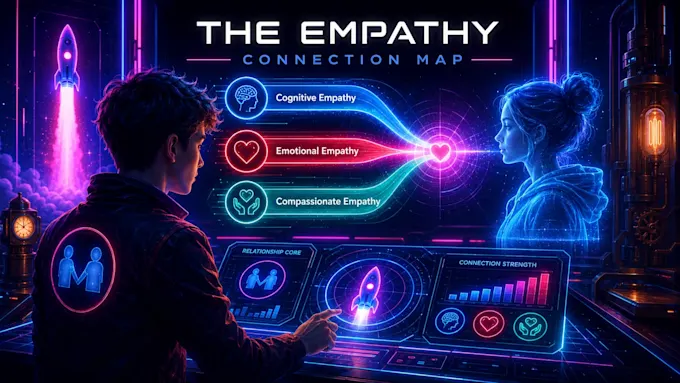
The types of empathy are three distinct but interconnected capacities: cognitive empathy (understanding another person's perspective intellectually), emotional empathy (feeling what another person feels), and compassionate empathy (being moved to take supportive action). Together, the 3 types of empathy form a complete framework for deep, meaningful human connection.
What Is Empathy and Why Most People Get It Wrong
Before diving into the 3 types of empathy, it helps to clear up a common misconception. Empathy is not the same as sympathy.
Sympathy is feeling for someone. You see their pain from a safe distance and offer your condolences. Empathy is feeling with someone. You enter their emotional world and try to understand their experience from the inside.
Brené Brown, whose TED Talk on empathy has been viewed over 30 million times, puts it simply: "Empathy fuels connection. Sympathy drives disconnection."
Empathy is also not a fixed trait you're born with or without. Research in neuroscience confirms that empathy is a set of learnable skills rooted in neural circuits, most notably the mirror neuron system, that can be deliberately strengthened over time.
This matters because what is emotional empathy, cognitive empathy, and compassionate empathy each recruit slightly different brain systems. To become a fully empathic person, you need to develop all three rather than just relying on whichever comes naturally.
The 3 Types of Empathy with Examples
Psychologist Paul Ekman, best known for his research on facial expressions and emotion, identified the framework that researchers now widely use when discussing the 3 types of empathy. Here's a deep look at each one.
1. Cognitive Empathy: Understanding Without Feeling
Cognitive empathy is the ability to understand what another person is thinking or feeling without necessarily experiencing those emotions yourself. It's perspective taking — the intellectual act of stepping into someone else's shoes and seeing the world through their lens.
This is the type of empathy most closely associated with emotional intelligence. When you accurately read what a colleague needs to hear before giving feedback, or when you instinctively adjust your tone because you sense someone is overwhelmed, that's cognitive empathy at work.
Example of cognitive empathy:
Your friend just lost their job. Instead of jumping straight into "here's what you should do," you pause and think: What is it like to feel that financial pressure and uncertainty right now? What would I need to hear in this moment? That mental shift, before you even open your mouth, is cognitive empathy.
The strength: Cognitive empathy makes you a better communicator, leader, negotiator, and problem solver. It lets you tailor your message to the person in front of you.
The blind spot: On its own, cognitive empathy can feel cold. People who are highly skilled at understanding others' perspectives without feeling them can come across as calculating or even manipulative. It needs to be paired with the next type.
Read More: What Makes People Happy
2. Emotional Empathy: Feeling What They Feel
What is emotional empathy? It's the capacity to actually feel another person's emotions as if they were your own. It's visceral, immediate, and often involuntary. When someone starts crying and your eyes well up too, or when a friend's anxiety makes your own chest tighten, that's emotional empathy.
This is the type of empathy driven most directly by the mirror neuron system, which causes your brain to simulate another person's emotional state. It's why a powerful film can make you sob for fictional characters, and why secondhand embarrassment is a real phenomenon.
Example of emotional empathy:
A colleague walks into a meeting visibly shaken after receiving difficult personal news. You haven't been told what happened, but you feel a wave of heaviness yourself and instinctively lower your own energy to match theirs rather than barreling in with your usual enthusiasm. That's emotional empathy running quietly in the background.
The strength: Emotional empathy is what makes people feel genuinely seen and not alone. It's the foundation of deep emotional bonds.
The blind spot: Without healthy boundaries, emotional empathy leads to empathy fatigue. You absorb so much of others' pain that you burn out and become less available to help. Healthcare workers and caregivers know this feeling well. The answer isn't to feel less. It's to develop the third type.
Read More: Signs That You are Emotionally Intelligent
3. Compassionate Empathy: Understanding, Feeling, and Acting
Compassionate empathy is the integration of the first two, plus action. You understand what someone is going through (cognitive), you feel moved by it (emotional), and you're motivated to help in a tangible, meaningful way (compassionate). It's empathy with its boots on.
This is arguably the most powerful of the 3 types of empathy because it closes the loop. It transforms inner awareness into outer impact.
Example of compassionate empathy:
A friend is going through a painful breakup. You listen without judgment, you feel the weight of their sadness alongside them, and then — without waiting to be asked — you show up with dinner, rearrange your Saturday, and sit with them through the hard night. That's compassionate empathy in full motion. If you want to see how this plays out across all your connections, here's a deeper look at how to build emotionally healthy relationships.
The strength: This is what turns good intentions into real support. It builds the kind of trust that defines the relationships people treasure most.
One important note: Compassionate empathy doesn't always mean taking on another person's burden. Sometimes the most compassionate action is helping someone find their own strength rather than rescuing them from every discomfort.
Read More: How to Practice Self-Love
What Does Empathy Look Like in Real Life?
What does empathy look like when it's actually working? It doesn't always look dramatic. In everyday interactions, it shows up in the smallest details.
It looks like maintaining eye contact instead of checking your phone when someone is talking — and if you want to go deeper, learning how to be a better listener in a relationship is one of the fastest ways to put empathy into daily practice. It looks like reflecting back what you heard before offering advice: "It sounds like you're feeling overlooked. Is that right?" It looks like noticing that a friend has gone quiet and sending a check in text, even when you're busy. It looks like resisting the urge to one up someone's struggle with your own.
What does empathy look like in conflict? It looks like pausing before you respond defensively. You take a breath, ask yourself what might be driving the other person's behavior, and speak to the feeling underneath the friction rather than matching its heat.
Research shows that people who regularly practice these habits of connection don't just have better relationships. They experience measurably lower stress, stronger immune function, and higher overall life satisfaction. These benefits ripple outward, positively affecting mental health, career performance, and physical wellbeing alike.
This is the quiet power of these practices. Building better habits in one area of your life has a way of improving all the others.
The 3 A's of Empathy
What are the 3 A's of empathy?
While the three type framework describes what empathy is, the 3 A's describe how to practice it in the moment. They're a practical, memorable structure for making empathy feel less like an abstract concept and more like a repeatable skill.
The 3 A's of empathy are: Awareness, Acknowledgment, and Action.
1. Awareness is the starting point. It means tuning in, noticing not just what someone says but how they say it, what their body language suggests, and what might be happening beneath the surface. Awareness is what activates your empathic response before you even speak.
2. Acknowledgment is the bridge. It means letting the other person know, through words, presence, or even a well timed silence, that you've registered their experience. This doesn't mean having the right answer. It often means saying something as simple as: "That sounds incredibly hard. I'm glad you told me." Acknowledgment is where people feel heard rather than managed.
3. Action is where empathy lands. It's the response, whether that's offering help, asking what the person needs, changing your behavior, or simply staying present. Importantly, action doesn't always mean doing more. Sometimes it means doing less, stepping back, and trusting someone's ability to navigate their own experience.
Together, the 3 A's of empathy create a complete cycle that's teachable, trainable, and immediately applicable in any relationship, personal or professional.
Levels of Empathy: From Surface to Transformative
Not all empathic responses are equal. Understanding the levels of empathy helps you recognize where you currently operate and how to go deeper.
Surface level empathy is acknowledgment without real engagement. "I hear you." "That sucks." It's polite, but it doesn't make someone feel truly seen. Most people operate here by default, especially in fast paced environments.
Reflective empathy goes a layer deeper. You mirror back what you've heard to show you've truly absorbed it: "So it sounds like you felt blindsided, and the part that hurts most is that it came from someone you trusted." This level requires active listening, and research suggests people only do this effectively about 25% of the time.
Deep or transformative empathy is the highest of the levels of empathy. At this level, you're not just processing someone's words. You're attuned to their values, their history, and the deeper need driving what they're expressing. You see the full human, not just the presenting problem. This is the level where genuine healing, trust, and growth become possible.
Reaching this level consistently takes practice. It requires you to slow down in a world that rewards speed, to tolerate emotional discomfort, and to care about the inner experience of others as much as the outer outcome of any given conversation.
How to Build All 3 Types of Empathy
Here's the good news: every type of empathy can be deliberately developed. The science of habit formation tells us that sustained practice rewires neural pathways, what neuroscientists call neuroplasticity. That means the person who currently struggles with empathy can, through consistent small actions, become someone for whom empathy feels entirely natural.
A few habits that build all three types simultaneously:
Practice perspective taking daily. Before reacting in a charged conversation, pause and ask yourself: What might this person be experiencing that I can't see? Even 10 seconds of this changes the quality of your response.
Develop your emotional vocabulary. Research by psychologist Lisa Feldman Barrett shows that the more granular your ability to name emotions, the better you are at identifying them in others. Move beyond "happy," "sad," and "angry." Learn to distinguish between disappointment and grief, between frustration and resentment.
Build a listening ritual. Schedule one conversation per week where your only goal is to understand the other person. No advice, no agenda. Ask open ended questions. Reflect back what you hear. Let silence do some of the work.
Read fiction. Studies show that reading literary fiction improves your ability to understand others' mental states, which is a key cognitive empathy skill. Even 30 minutes a few times a week makes a measurable difference.
Acknowledge your own emotions first. Emotional empathy suffers when you're disconnected from your own inner life. A brief daily check in, asking yourself What am I feeling right now, and why? builds the self awareness that makes reading others possible. Learning how to self reflect is one of the best investments you can make in your empathic capacity.
The shift here isn't just about becoming kinder. It's about becoming someone who naturally shows up this way, an identity level change rather than just a behavior tweak. That's when empathy stops being something you work at and starts being simply who you are. This is what identity-based habit change is all about.
Conclusion: The Relationship That Changes Everything
Think back to that moment from the opening. Someone needed you, and the connection fell flat. You weren't failing them out of selfishness. You were missing a map.
Now you have one.
The types of empathy aren't abstract psychological concepts. They're the specific, learnable skills that determine whether your relationships stay surface level or become the kind that the Harvard researchers found to be the single greatest predictor of a long, happy life. Cognitive empathy helps you understand. Emotional empathy helps you feel. Compassionate empathy helps you act.
And here's what's particularly exciting: getting better at these 3 types of empathy doesn't just improve your relationships. It creates a ripple effect across every area of life, your confidence, your stress levels, your sense of purpose. The person who shows up fully for others tends to show up better for themselves too.
The 75 year Harvard study isn't a story about genius, ambition, or even luck. It's a story about connection. And connection starts with choosing to truly understand the person in front of you.
Start with one of the habits from this article. Let it grow. And watch what happens.
🚀 READY TO BUILD RELATIONSHIPS THAT ACTUALLY TRANSFORM YOUR LIFE?
You now understand the 3 types of empathy and how to start building them, but that's only one piece of the momentum puzzle.
True connection isn't just about one skill in one relationship. It's about becoming the kind of person who shows up fully across every core area of their life, and that kind of identity level transformation is exactly what the Moore Momentum System is built for.
👉 Take the Core Values Quiz right now to discover where your Relationships Core stands today and get a personalized, science backed roadmap for your most important next step. It takes under 60 seconds and gives you immediate clarity on the habits that will move the needle most.
Growth in your relationships ripples into your mindset, your career, your health, and your emotional wellbeing. The system is designed to make that growth simple, engaging, and impossible to quit.
Begin your transformation — take the Core Values Quiz NOW.
🚀🚀🚀 Don't forget to check out our Resource Arcade 👾🎮 for FREE templates and tools to gamify your habits.

FAQs on Levels of Empathy
What is the difference between empathy and sympathy?
Sympathy means feeling for someone — acknowledging their pain from a distance, often with pity or concern. Empathy means feeling with someone, stepping into their emotional experience and understanding it from the inside. Sympathy says "I feel sorry for you." Empathy says "I feel what you feel." The distinction matters because sympathy, however kind, can create emotional distance, while empathy creates genuine connection.
Can empathy be learned, or is it something you're born with?
Empathy is both a natural tendency and a trainable skill. While some people are naturally more attuned to others' emotions, research in neuroscience confirms that the brain circuits underlying empathy are highly plastic and can be strengthened through consistent practice. Techniques like active listening, perspective taking exercises, and emotional journaling have all been shown to measurably improve empathic ability over time. Nobody is locked into their current level.
Is it possible to have too much empathy?
Yes. When emotional empathy is not balanced by healthy boundaries, it can lead to empathy fatigue, a state of emotional exhaustion caused by absorbing too much of others' pain. This is common among caregivers, therapists, and highly sensitive individuals. The solution isn't to feel less. It's to develop compassionate empathy alongside emotional empathy so you can care deeply and protect your own wellbeing at the same time. Setting boundaries isn't a failure of empathy. It's what makes sustainable empathy possible.
Why do some people struggle with empathy?
Difficulty with empathy can stem from a variety of factors including upbringing, chronic stress, certain personality traits, or a condition called alexithymia, which is a restricted ability to identify and name emotions. Importantly, most empathy struggles are not fixed deficits. With self awareness, the right habits, and sometimes professional guidance, people across a wide range of starting points can significantly improve their capacity to connect with others.
Are there any coaching services that focus on teaching the 3 types of empathy?
Yes. If you're looking to develop the 3 types of empathy in a structured, personalized way, coaching can dramatically accelerate the process. Life Coaching works directly with individuals to build the emotional intelligence skills, including cognitive, emotional, and compassionate empathy, that strengthen every relationship in your life. Whether you're focused on personal connections or professional communication, working with an experienced coach gives you personalized feedback and accountability that self directed learning rarely provides. Not sure whether coaching or therapy is the right fit for you? This breakdown of life coaching vs therapy can help you decide.
How does empathy impact leadership and the workplace?
Empathy is one of the most critical and consistently underrated leadership skills. Studies show that employees who feel understood by their managers report higher engagement, lower burnout, and stronger performance. Cognitive empathy helps leaders communicate more effectively. Emotional empathy builds trust and loyalty. Compassionate empathy drives a culture where people feel safe to take risks, raise concerns, and do their best work. In short, empathy isn't soft. It's a strategic advantage and it's a core focus of executive coaching for a reason.


Founder & CEO of Moore Momentum
Will Moore is a serial entrepreneur, life coach, and habit science expert with a $300M+ exit under his belt. After hitting suicidal rock-bottom as a teen, he dedicated his life to cracking the code on lasting happiness and success — and built Moore Momentum to share what he found.
He helps people discover WHO they are, WHAT they really want, and HOW to get there by combining proven principles, science, AI, and gamification.
His mission: make growth ethically addictive and inevitable.