




What Is Executive Coaching? Guide to Leadership Growth
For years, I struggled with ADHD as an entrepreneur: scattered focus, endless to-do lists, and the overwhelming feeling that I was always one step behind. Then I discovered something that changed everything. The Pareto Principle.
The revelation was simple but profound. Eighty percent of my results came from just 20% of my efforts. The moment I focused ruthlessly on that vital 20%, everything shifted. I wasn't working harder. I was finally understanding how behavior change actually works, and building momentum around what mattered most.
That same gap exists in leadership today. You know what you should do. You've read the books, attended the workshops, maybe even hired a coach. You have the awareness. But your daily habits? They haven't changed. You're still drowning in emails, reacting instead of leading, and wondering why professional growth feels so elusive.
So what is executive coaching in 2026, and how has it evolved beyond awareness to create lasting action? The answer lies in understanding not just what the work is, but how modern approaches bridge the gap between knowing and doing, using behavioral science, AI personalization, and systems that make leadership potential inevitable rather than aspirational.
Here's what you'll discover:
The complete definition of this work, and what it is NOT
The 8 critical dimensions every leader must understand
Executive coaching benefits backed by research, and when they actually deliver ROI
How to choose the right coach, or the right system, for your situation
Importance of Executive coaching for women
Modern AI-driven approaches that turn awareness into automatic action
What Is Executive Coaching? The Complete Definition
Executive coaching is a confidential, goal-driven partnership between an International Coaching Federation certified coach and a senior leader, designed to accelerate professional growth through self-awareness, behavioral science, and structured accountability. Unlike therapy or mentoring, it is future-focused and action-oriented, helping leaders close the gap between knowing what to do and consistently doing it.
That distinction matters more than most leaders realize. Therapy addresses past trauma. Mentoring dispenses advice from experience. Coaching does neither. Instead, it uses powerful questions, behavioral assessments, and accountability structures to surface insights the leader already holds but hasn't yet acted on.
A typical engagement runs three to twelve months. It begins with comprehensive discovery: 360-degree stakeholder interviews, personality assessments, and emotional intelligence evaluations that map blind spots and growth opportunities. From there, regular sessions become the space where leaders stress-test decisions, refine their leadership style, and build the habits that compound into lasting performance change.
The field has traveled a long road. Through the 1980s and 1990s, this work carried a remediation stigma, something companies arranged for struggling leaders as a quiet intervention. That changed. When Harvard Business Review surveyed 140 leading coaches in 2009, the finding was clear: a decade earlier most companies hired a coach to fix toxic behavior at the top, but by then the majority of engagements had shifted to developing high-potential performers and serving as a sounding board for capable leaders.
Modern approaches have evolved further still, integrating neuroscience, positive psychology, and AI-driven personalization to move beyond insight into sustained behavior change. The most effective programs today don't just build awareness. They build momentum.
Understanding this discipline also means understanding what separates it from adjacent ones. The most common source of confusion is the life coach vs executive coach distinction, which we'll address next, along with six myths that quietly shape how leaders think about hiring before they ever make the call.
Life Coach vs Executive Coach: What's the Difference?
Life coaches focus on personal development across life areas: relationships, health, mindset, and fulfillment. They help clients achieve personal goals and improve work-life balance.
Executive coaches specialize in professional growth: leadership skills, career advancement, and workplace performance. They work with business leaders to sharpen management ability, strategic thinking, and organizational impact.
Both drive transformation, but they differ in scope. Life coaches address holistic wellness. Executive coaches optimize professional success.
Life Coach | Executive Coach | |
Primary focus | Personal fulfillment across all life areas | Leadership performance and organizational impact |
Typical client | Anyone navigating a personal transition | VP level and above, founders, high-potential talent |
Who pays | Usually the individual | Usually the employer |
Success measure | Life satisfaction, personal goal attainment | 360 feedback shifts, promotion, team performance |
Credential to look for | ICF certification (ACC, PCC, MCC) | ICF PCC or MCC, plus senior leadership background |
Typical engagement | 3 to 6 months, flexible cadence | 3 to 12 months, biweekly or monthly |
The life coach vs executive coach decision usually comes down to one question: is your challenge contained inside your job, or does it show up everywhere?
What Executive Coaching Is NOT: Dispelling 6 Common Myths
Before we explore how the process works, let's clear up what it isn't.
Myth 1: "It's only for underperforming executives"
Truth: Modern engagements are proactive development for high performers, not a remediation or last-resort tool. The best leaders use a coach to sharpen their edge, not to fix a problem.
Myth 2: "It's the same as therapy or counseling"
Truth: Counseling addresses past trauma and psychological issues. This work is future-oriented, focused on leadership potential and measurable goals rather than emotional healing.
Myth 3: "It's just expensive advice from a mentor"
Truth: Mentoring involves an experienced leader sharing wisdom: "Here's what I did." Coaching facilitates self-discovery through powerful questions: "What options do you see?"
Myth 4: "Executive and life coaching are identical"
Truth: Life coaching covers broad personal domains. The executive version targets leadership skills, business performance, and organizational impact with higher stakes and greater specificity.
Myth 5: "Anyone can call themselves a coach"
Truth: Reputable practitioners hold professional certification from the International Coaching Federation. This is an unregulated industry with pretenders in it, so credentials matter.
Myth 6: "Coaching fixes organizational problems"
Truth: Coaching develops individuals. Consulting fixes systems. Better leadership helps, but systemic organizational problems require different interventions.
Now that we've established what the work isn't, let's look at how it actually runs.

How Executive Coaching Works: The 6-Stage Journey
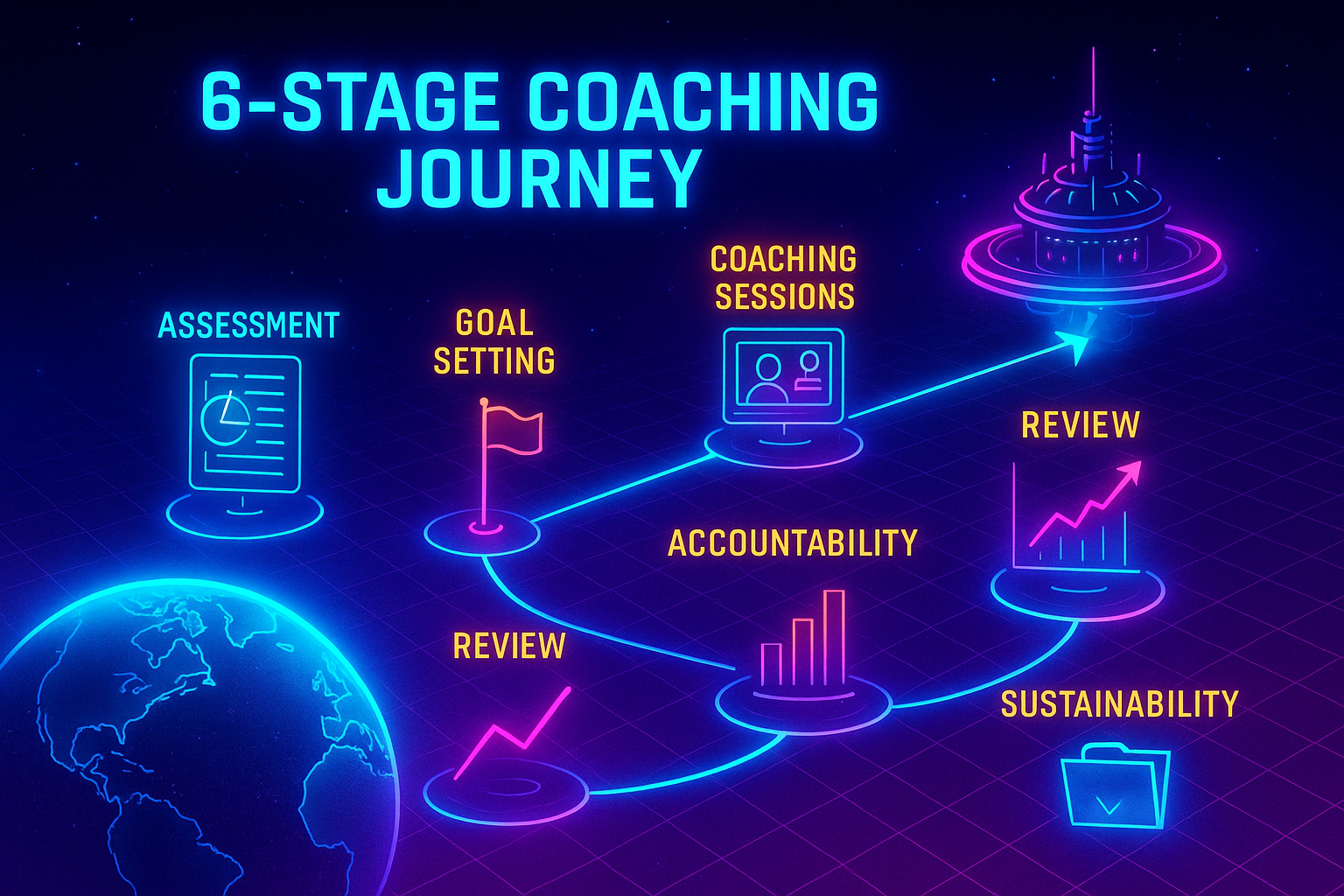
Understanding the process helps set realistic expectations. Here's what a typical engagement looks like from start to finish.
Stage 1: Initial Assessment (2 to 4 weeks)
The journey begins with comprehensive discovery. Your coach conducts 360-degree interviews with direct reports, peers, and supervisors to gather stakeholder feedback. You'll complete personality and emotional intelligence assessments to understand your behavioral patterns and strengths. This data identifies the core leadership issues worth working on.
Stage 2: Goal Setting and Contracting (1 week)
Together you define measurable goals aligned with your core purpose: what you want to accomplish and why it matters. This becomes the roadmap for the engagement. If you're building that roadmap now, our breakdown of the 7 steps of goal setting gives you a framework to bring into that first conversation.
Stage 3: Sessions (3 to 12 months)
Regular 60 to 90 minute sessions, typically biweekly or monthly, become your thinking space. Through skilled facilitation, your coach helps you explore leadership challenges, test solutions, and refine strategy. Between meetings, you implement insights and track progress.
Stage 4: Implementation and Accountability (ongoing)
This is where the engagement either succeeds or stalls. You're applying new behaviors in real time and working toward measurable goal attainment while your coach holds the line.
Stage 5: Review and Adjustment (periodic)
Progress check-ins assess what's working. Goals get recalibrated based on results and changing circumstances.
Stage 6: Transition and Sustainability (final month)
The engagement concludes by consolidating learnings into a leadership development plan. Some leaders opt for onboarding support if they're moving into a new role.
The gap? Sessions happen one to two times monthly. That is roughly two to four hours out of about 480 waking hours in a month, or under 1% of your time with support. What happens during the other 99%, when old habits creep back?
Executive Coaching Types: Matching the Approach to Your Needs
Not every engagement looks the same. Understanding the different types of executive coaching, and the models behind them, helps you find the right fit.
Common Types by Focus Area
Performance coaching targets specific skill enhancement and goal attainment. If you need measurable results quickly, whether that's closing deals, improving presentations, or managing time, this is your approach.
Leadership coaching develops executive presence, team performance, and organizational influence. It's about how you lead, not just what you accomplish.
Career coaching guides transitions and career development strategy, whether you're aiming for the C-suite, pivoting industries, or considering entrepreneurship.
Business coaching supports founders and entrepreneurs with scaling challenges, strategic planning, and building sustainable ventures.
Developmental coaching takes a longer view, cultivating leadership potential over years rather than months. Think succession planning and legacy building.
Skills coaching zeroes in on specific competencies such as communication, decision-making, and conflict resolution, with targeted practice.
Because these types of executive coaching carry different scopes, they also carry different price tags, which is why executive coaching cost varies so widely across otherwise similar engagements. We break the numbers down in the FAQ below.
Popular Executive Coaching Models
The GROW Model (Goal, Reality, Options, Will) remains the most widely used framework for structured problem-solving.
Positive psychology coaching takes a strengths-based approach, focusing on what's already working rather than fixing weaknesses.
Transformational coaching goes deep, addressing identity-level change and values alignment for lasting impact.
Most ICF-certified practitioners blend these approaches, customizing to your needs. But here's what all traditional models share: they rely on your willpower between sessions.
Who benefits most from these approaches? Let's look.
Is Executive Coaching Right for You? Who Benefits Most
This isn't just for CEOs. The most effective leaders at every level use a coach strategically to accelerate growth.
Ideal Candidates by Role
C-suite executives manage complexity, navigate stakeholder relationships, and build lasting legacies. At this level every decision has amplified impact, and a coach provides the thinking space to get it right.
Rising leaders transitioning from individual contributor to manager, or manager to VP, benefit enormously. These inflection points demand new leadership skills, and developmental work accelerates the learning curve.
Founders and entrepreneurs face a distinct set of challenges: scaling beyond themselves, building leadership teams, and holding vision while managing operations. A coach provides the outside perspective employees can't safely offer.
High-potential talent on accelerated development tracks use coaching to maximize their trajectory. Companies invest here because the return compounds across an entire career.
Ideal Situations
New role transitions, especially structured onboarding support for executives, measurably improve success rates. Team performance challenges, work-life integration struggles, and career plateaus all signal an opening.
Emotional intelligence is often the specific capability leaders come in wanting to build, and it's one of the areas where structured feedback moves the needle fastest.
So how do you find the right person?
Choosing an Executive Coach: 8 Essential Criteria
Not all coaches deliver equal results. Here's what separates the exceptional from the expensive conversation.
1. Professional Credentials
Look for certification from the International Coaching Federation, specifically PCC (Professional Certified Coach) or MCC (Master Certified Coach). These require hundreds of documented hours and demonstrated competency. Ethical guidelines, including client confidentiality, should be non-negotiable.
2. Relevant Experience
The best practitioners combine real leadership and corporate experience with coaching expertise. They understand executive pressure from the inside, not just from a textbook.
3. Proven Track Record
Ask about outcomes. Request client testimonials and case studies. Check references and LinkedIn recommendations.
4. Style Compatibility
Some coaches are directive, others purely facilitative. Their style should match how you learn. The most effective arrangement is a client-driven process where you set the agenda.
5. Clear Methodology
Strong coaches articulate their process clearly: how they gather feedback, how they track progress against measurable goals, and how they adjust when something isn't landing.
6. Confidentiality and Ethics
Client confidentiality must be absolute. Confirm there are no conflicts of interest with your organization.
7. Accountability Between Sessions
This is where most traditional arrangements fall short. How does this person support you during the 99% of the month when you're not in a session? Many coaches don't have a good answer, and that gap is exactly where modern approaches are gaining ground.
8. Chemistry and Trust
The relationship requires trust. Schedule a chemistry session before committing so you can confirm rapport exists.
A word of caution: this remains an unregulated industry. Be wary of anyone without ICF credentials, anyone promising a quick fix, and anyone who treats client confidentiality as negotiable. If you want a structured vetting process, our guide on how to find an executive coach walks through the questions to ask before you sign.
With the right person selected, what results can you expect?
Executive Coaching Benefits: What the Research Shows
Is Executive Coaching Worth It?
The evidence is genuinely encouraging, with one important caveat: most of it comes from self-reported client surveys, and the largest datasets are now more than a decade old.
In the ICF and PricewaterhouseCoopers Global Coaching Client Study (2009), which surveyed 2,165 clients across 64 countries, 86% of the companies that were able to calculate an ROI figure reported at least making their investment back. The median organizational return in that study was roughly seven times the amount spent. Separately, the Manchester Review study of 100 executives (McGovern et al., 2001) reported an average return of 5.7 times the initial investment.
Treat those figures as directional rather than guaranteed. Both studies rely on participants who chose coaching in the first place, which is a known source of optimism bias. What they establish is a defensible expectation, not a promise.
The more useful measure isn't a percentage at all. It's what actually changes across five dimensions of a leader's life.
The 5 Dimensions of Lasting Change
🧠 Enhanced mental and strategic capability. You develop self-awareness and self-regulation, the foundation of effective leadership. Decision-making sharpens. Strategic thinking widens. And a growth mindset starts replacing the defensive reflex that used to run the room.
💼 Career and financial advancement. The work clarifies your career pathway and aligns your purpose with the job in front of you. Clients report promotions, expanded scope, and professional growth that compounds over decades. It isn't just about the next role. It's about the trajectory.
👥 Improved relationships and team dynamics. Emotional intelligence transforms how you lead. Team performance improves as you master difficult conversations, build stronger professional networks, and create psychological safety. Your influence expands beyond your title.
💪 Sustainable performance and well-being. Good coaching addresses energy management, not heroic effort. The goal is a set of systems that let you perform at your best without burning out. Work-life integration becomes possible instead of aspirational.
🧘 Leadership presence and impact. You develop gravitas, stress resilience, and an authentic leadership style. The focus shifts from proving yourself to making a lasting mark. Self-regulation lets you lead from clarity rather than reactivity.
Notice the pattern. The most durable executive coaching benefits refuse to isolate professional skill from personal well-being. But to get there, we have to be honest about where traditional approaches run out of road.
Why Traditional Coaching Creates Awareness But Not Always Action
Here's the uncomfortable truth: awareness doesn't equal change.
Behavioral scientists call this the intention-behavior gap, and it is one of the most robust findings in the field. In their synthesis of the research, Paschal Sheeran and Thomas Webb (2016) found that meta-analytic evidence converges on a blunt conclusion: people routinely fail to do the things they fully intend to do. Forming the intention is not the hard part. Acting on it is.
You learn in a session that you need to delegate more. You intellectually agree. Three months later you're still drowning in tasks. Why?
Leaders usually diagnose this as a discipline problem and try to push harder. It rarely works, because the real issue is a mismatch between the behavior and the system around it. Our breakdown of why procrastination isn't a willpower problem unpacks that distinction, and it's the same logic that explains why a monthly session can't carry a daily behavior.
The missing piece is habit formation infrastructure.
The Neuroscience of Behavior Change
Your brain runs on a simple loop: cue, craving, response, reward. Every habit, good or bad, follows this pattern.
Consider a scenario nearly every executive recognizes:
Cue: morning email notification
Craving: the need to feel on top of things
Response: two hours spent reactively answering email
Reward: inbox zero, and temporary relief
Result: no time left for strategic work
Sessions help you recognize the pattern. But between monthly meetings, the old neural pathways still fire automatically. Recognition alone doesn't rewire them. You need systems that redesign the environment, make new behavior the path of least resistance, and deliver an immediate reward for progress.
This is where modern approaches diverge from tradition, combining human wisdom with behavioral science and AI to deliver what a monthly meeting structurally cannot: daily accountability, personalized guidance, and habit architecture that runs whether or not anyone is watching.
But first, one more distinction that regularly trips leaders up.
Leadership Coaching vs Executive Coaching vs Mentoring: What's the Difference?
These terms get used interchangeably, but the distinctions matter, and choosing the wrong one costs both time and money.
Executive Coaching and Mentoring
The executive coaching and mentoring comparison is where most leaders get confused first. Mentoring is advice-driven and relationship-based. Your mentor says, "Here's how I handled that when I was VP of Sales." It's wisdom transfer from someone who has walked the path.
Coaching works differently. It facilitates self-discovery through powerful questions rather than ready-made answers. Your coach asks, "What options do you see? What would success look like?" The insight comes from you. The coach creates the conditions for it to surface.
When does each work best? Mentoring excels for industry navigation, political dynamics, and learning a specific playbook. Coaching excels for skill development, performance improvement, and sustainable behavior change, particularly when your challenge is unique enough that no mentor's playbook quite fits. In practice the two aren't competitors. Many leaders benefit from both at once.
Leadership Coaching vs Executive Coaching
The leadership coaching vs executive coaching distinction is largely one of scope, not substance. Leadership coaching may span all management levels, from new team leads to senior directors. The executive tier typically targets VP level and above, where stakes, complexity, and organizational impact are highest. But the client-driven process, the future orientation, and the behavioral science foundation stay the same across both.
The practical takeaway: focus on outcomes and methodology, not the label on the tin. Whatever someone calls it, ask what their process is, how they measure progress, and what happens between sessions.
Coaching vs Consulting vs Training vs Counseling
Four disciplines that get conflated constantly, each serving a different purpose:
Discipline | Who supplies the answer | Time orientation | Best used when |
Consulting | The expert diagnoses and solves | Present problem | You need a systemic fix delivered |
Training | The curriculum drives learning | Present skill gap | A group needs the same capability |
Counseling | The therapist guides healing | Backward-looking | Past experience is limiting the present |
Coaching | The individual, drawn out by questions | Forward-looking | You know the goal but not the path to it |
If you're still weighing which format fits your situation, our guide on how to find a life coach walks through evaluating credentials, formats, and fit before you commit.
Now let's address a dimension that deserves its own section.
Executive Coaching for Women: Addressing Systemic Barriers and Building Resilience
The Unique Challenges Women Leaders Face
Executive coaching for women has to address a reality most leadership development programs still sidestep: the double bind. Be assertive and risk being labeled aggressive. Be collaborative and risk being read as weak.
This isn't a matter of perception. Catalyst's double-bind research documented three specific predicaments women leaders face: extreme perceptions, in which women are seen as too soft or too tough but never just right; a higher competence threshold paired with lower rewards; and the competent-but-disliked trap, where clearly demonstrating leadership behavior costs likability. Because women are evaluated against a masculine default standard, the report concluded, they're left with limited and unfavorable options no matter how they actually lead.
What makes the double bind so stubborn is that it runs on autopilot. The evaluations behind it form in a fraction of a second, before anyone consciously weighs the evidence, which is why the snap-judgment reflex is worth understanding whether you're the leader being assessed or the one doing the assessing in a 360 review.
Layer onto that work-life integration pressure, imposter syndrome that persists despite clear qualifications, fewer role models at senior levels, and network gaps that limit access to sponsors and high-stakes opportunities. Stakeholder feedback for women leaders often contains contradictory signals about style, with the goalposts shifting depending on who's in the room.
Why Women Leaders Need Holistic Support
Traditional approaches often focus on fixing the woman: be more assertive, more strategic, more visible. That framing ignores the system she's operating inside. Effective executive coaching for women does both. It names the structural barriers honestly while building the internal resilience that holds regardless of what the environment throws at her.
In practice, that holistic approach spans five dimensions of a leader's life:
Mindset: reframing imposter syndrome and building confidence that doesn't depend on external validation
Career and finances: negotiation strategy, visibility tactics, and a leadership style that works within existing systems and, where necessary, challenges them
Relationships: authentic professional networks, sponsor relationships, and accountability structures that support long-term growth
Physical health: sustainable energy management and boundaries that protect performance
Emotional and mental health: stress resilience and recovery practices that make presence possible under pressure
Here's the bigger truth. Women leaders often pioneer this integrated approach because they feel the cost of imbalance first and most acutely. But the framework itself isn't gender-specific. Understanding how progress in one area of life ripples into the others is what separates leaders who sustain high performance from those who burn out reaching it.
So the question isn't whether executive coaching for women should be holistic. It clearly should. The question is whether monthly sessions alone can deliver that. They can't, and that's why the future of leadership development looks different.
From Coaching Sessions to Daily Momentum: The Future of Executive Development
The Session-Based Limitation
Let's be honest about the fundamental constraint. One to two sessions per month is roughly two to four hours out of about 480 waking hours. Under 1% of your time with support. More than 99% without.
In that 99%, there's no accountability structure, no daily guidance, and no real-time course correction. Old habits return. Insights fade. Willpower depletes. This isn't a failure of coaches or of coaching. It's a structural limitation of the session-based model.
What's needed is something closer to a coach in your pocket.
What Habit Architecture Actually Looks Like
The alternative isn't a better coach. It's a daily operating system that carries the insight forward between conversations. It works in three moves.
Move 1: Find the one habit that moves everything
Most people fail at behavior change because they try to change everything at once. Instead, identify your biggest friction point across five areas of life: mindset, career and finances, relationships, physical health, and emotional and mental health. Then narrow from that broad pain point to a single specific behavior. Say you're overwhelmed and reactive with no time to think. The analysis: your morning has no structure and email triggers reactivity. The habit: a 15-minute strategic planning block from 6:00 to 6:15 a.m., before your inbox opens.
Move 2: Engineer the friction out
A habit survives on design, not discipline. Make it obvious with a calendar block and a visible cue, like the planning notebook sitting on your desk the night before. Make it easy by prepping materials in advance and using a template so there's no blank page at 6 a.m. Make it rewarding by tracking weekly wins and marking the month you didn't miss.
Move 3: Close the loop daily
Two minutes each morning to set intent. Three minutes each evening to score how the day went on a one-to-five scale and log what you learned. That's five minutes. It's the difference between insight you had once and identity you're actively building. Add streaks, visible progress, and a small reward for consistency, and the accountability stops depending on willpower entirely.
That's habit formation infrastructure, and it's what turns awareness, whether it came from a coach, a book, or a workshop, into behavior that survives a hard week. If you want a starting structure, our weekly habit tracker gives you the daily loop in a format you can use tomorrow.
The Future of Executive Coaching: From Awareness to Inevitable Action
Here's what it comes down to.
Every coaching conversation, every leadership workshop, every book you've underlined and put back on the shelf produces the same thing: awareness. And awareness is valuable. But awareness without a daily system to act on it is just expensive self-knowledge.
The shift happening in leadership development right now isn't about finding a better coach or a smarter framework. It's about recognizing that behavior change happens in the 99% of the month between sessions, and building the infrastructure to win those hours rather than just the 1% when someone is watching.
Traditional coaching builds awareness. Daily systems build identity. The best approach combines both: someone who helps you see clearly, and an architecture that makes acting on that clarity automatic rather than aspirational. If you want to understand how that works at the neurological level, our breakdown of the habit loop explains why old patterns survive even when you know better, and what it takes to rewire them for good.
Remember the Pareto Principle breakthrough from the opening? The one that cut through my ADHD-driven entrepreneurial chaos and showed me that 80% of my results came from 20% of my effort? That wasn't an insight I visited once a month. It became a daily filter, a habit of mind that ran automatically because I built systems around it instead of just knowing about it.
The same principle applies to your leadership. Knowing your blind spots is step one. Building the daily momentum that makes your next level inevitable is step two. And the leaders who reach that second step aren't necessarily the ones with the best coaches. They're the ones who learned how to turn growth into something they're pulled toward rather than pushed into.
The question isn't whether you need support. It's whether you'll settle for awareness without action, or build a system designed to make transformation inevitable.
Your answer will determine whether you're wrestling with the same leadership challenges a year from now, or whether you've built the kind of unstoppable momentum that compounds into the leader, and the life, you're fully capable of creating.
🚀 TIRED OF AWARENESS WITHOUT ACTION? THERE'S A SYSTEM FOR THAT.
You just learned why traditional coaching creates insight but rarely creates lasting change, and what it actually takes to close that gap. The strategies behind this article don't live in a session that happens twice a month. They live in a daily system that rewires your habits, tracks your momentum across all 5 Core Areas of Life, and makes leadership growth feel less like discipline and more like a game you actually want to play.
That system is the Moore Momentum System, our own science-backed, AI-personalized platform, built for leaders who are done with awareness that doesn't stick.
👉 Take the Core Values Quiz in under 60 seconds and get your personalized Momentum Score, revealing exactly which of your 5 Core Areas is quietly draining your leadership effectiveness and where your highest-leverage habit lives right now.
🚀🚀🚀 Don't forget to check out our Resource Arcade 👾🎮 for FREE templates and tools to gamify your habits.

FAQs About What is Executive Coaching
How much does executive coaching cost?
Executive coaching cost typically runs between $200 and $600 per hour for individual sessions, with comprehensive six to twelve month programs ranging from roughly $7,500 to $30,000. C-suite work at the premium end can exceed $1,000 per hour. For context, the 2023 ICF Global Coaching Study put the average North American fee across all coaching specialties at about $272 per hour, against a global average near $244. What you pay depends on your seniority, your coach's credentials, and the scope of the engagement.
How long does executive coaching last?
Most engagements run three to twelve months, with biweekly or monthly sessions of sixty to ninety minutes. Shorter engagements of three to six months suit targeted skill development. Longer programs of six to twelve months are better suited to deeper behavioral change, identity-level transformation, or a major transition such as stepping into a C-suite role.
What is the difference between executive coaching and mentoring?
Coaching facilitates self-discovery through powerful questions and structured accountability, so the insight comes from the leader. Mentoring transfers wisdom from someone who has walked a similar path, so the mentor shares what worked for them. Coaching excels when the challenge is specific to your context and no existing playbook quite applies. Both are valuable, and they serve different purposes at different career stages.
What credentials should a coach have?
Look for certification from the International Coaching Federation, specifically PCC (Professional Certified Coach) or MCC (Master Certified Coach). These require hundreds of documented coaching hours and demonstrated competency. Be cautious in an unregulated industry where anyone can claim the title. Credentials and a verifiable track record are non-negotiable.
Is executive coaching worth it?
The research is encouraging but should be read carefully. The Manchester Review study of 100 executives (2001) found an average return of 5.7 times the investment, and the ICF and PwC Global Coaching Client Study (2009) found that 86% of companies able to calculate ROI at least made their money back. Both rely on self-reported data from people who chose coaching, so treat them as directional. Returns depend heavily on your readiness to act on feedback and the quality of accountability during the 99% of the month when no session is happening.
What is the difference between a life coach and an executive coach?
A life coach addresses personal development across all areas of life: mindset, relationships, health, and fulfillment. An executive coach focuses specifically on professional performance, leadership skill, and organizational impact. The distinction matters when choosing support. If the challenge is primarily professional, go executive. If it spans multiple life domains, a life coach or a holistic system will serve you better.


Founder & CEO of Moore Momentum
Will Moore is a serial entrepreneur, life coach, and habit science expert with a $300M+ exit under his belt. After hitting suicidal rock-bottom as a teen, he dedicated his life to cracking the code on lasting happiness and success — and built Moore Momentum to share what he found.
He helps people discover WHO they are, WHAT they really want, and HOW to get there by combining proven principles, science, AI, and gamification.
His mission: make growth ethically addictive and inevitable.