




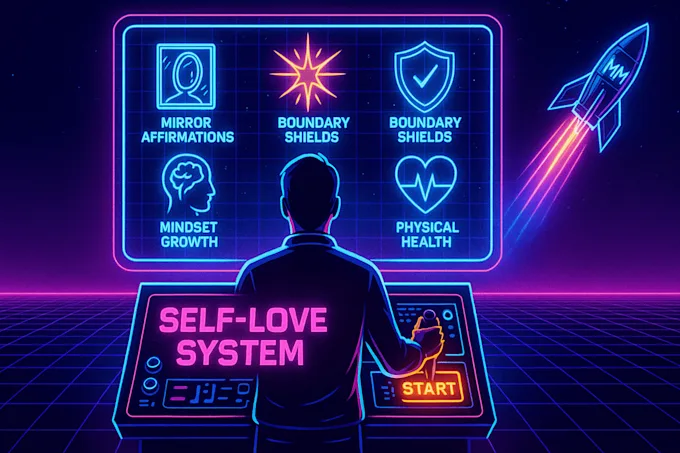
How to Learn to Love Yourself First: A Step-by-Step Guide
I'll never forget the moment I realized I was my own worst enemy. I was 25, sitting in my car after another failed business venture, replaying every mistake in my head like a highlight reel of incompetence. "You're such an idiot," I muttered to myself. "What made you think you could pull this off?"
The irony hit me later: I would never speak to a friend the way I spoke to myself. I'd spent years treating myself like someone who needed to be fixed, managed, and constantly criticized into improvement. What I didn't realize was that this harsh internal taskmaster wasn't making me better—it was keeping me stuck.
Learning to love yourself first isn't selfish. It's foundational. You can't pour from an empty cup, build meaningful relationships from a place of unworthiness, or chase your biggest goals while constantly sabotaging yourself with negative self-talk. How to learn to love yourself is one of the most important questions you'll ever answer because everything else in your life flows from it.
Here's what you'll gain from this guide:
Awareness of your current self-talk patterns and how they're holding you back
Practical tools to reframe negative thoughts using neuroscience-backed methods
A daily system for building self-compassion without feeling selfish or self-indulgent
Clear boundaries that protect your energy and demonstrate self-respect
Small habits that compound into lasting self-love and confidence
A supportive framework for continuous growth across all areas of your life
The path to loving yourself first isn't about becoming someone new. It's about removing the layers of harsh judgment, comparison, and criticism that have been covering up who you really are. Let's begin.

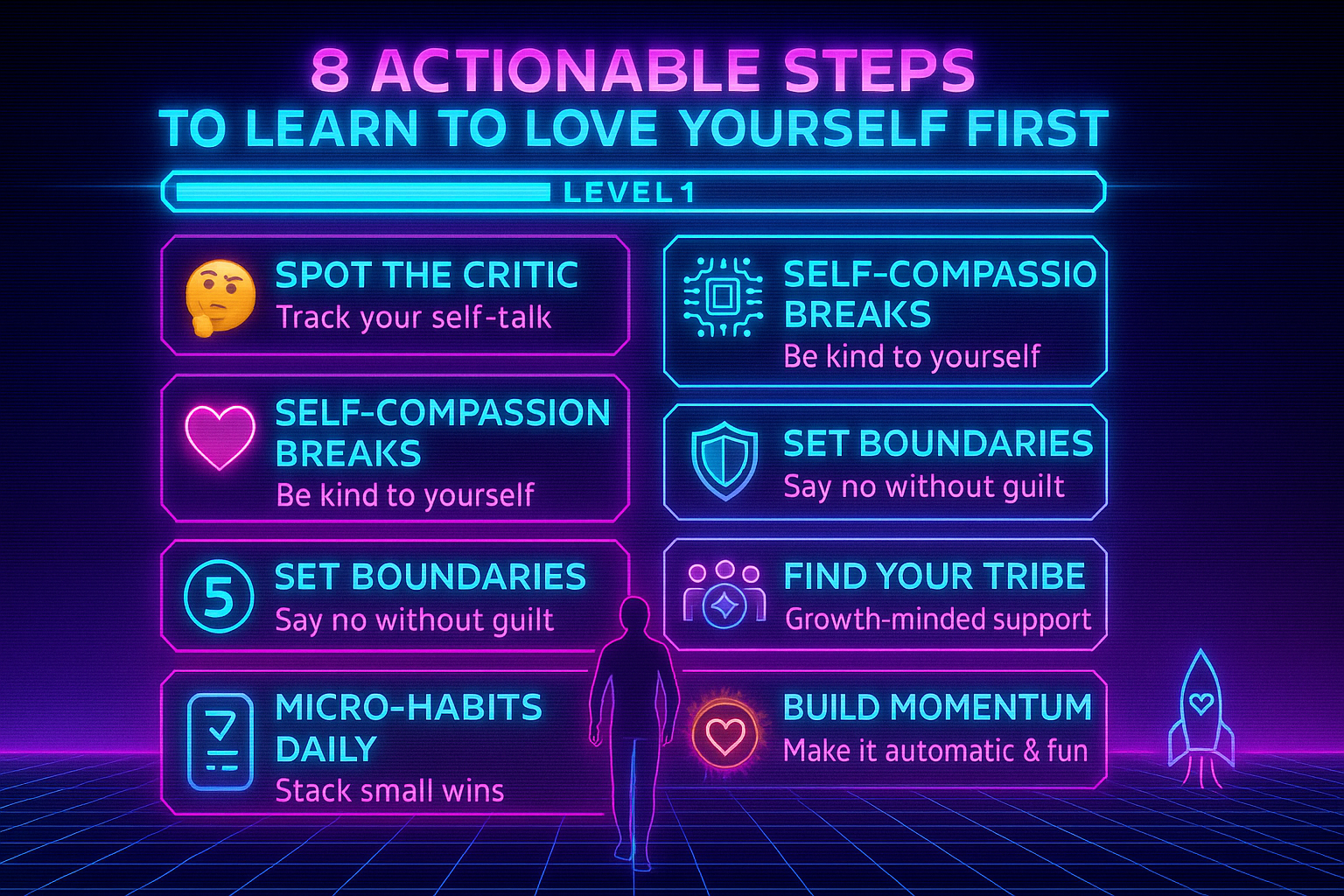
How to Learn to Love Yourself: 8 Actionable Steps
Step 1: The Awareness Audit: Catching the 'Internal Saboteur' in Real Time
You can't change what you're not aware of. That voice in your head—the one that comments on everything you do, say, and think—has been running on autopilot for years. For most of us, it's not exactly encouraging.
The first step in how to love yourself is simply noticing what you're telling yourself throughout the day. Are you constantly criticizing your appearance? Replaying social interactions and cringing at what you said? Comparing your behind-the-scenes to everyone else's highlight reel? Are you running after perfectionism?
This awareness is crucial because your brain doesn't distinguish between thoughts about yourself and facts about yourself. When you repeatedly think "I'm not good enough," your brain treats it as reality and looks for evidence to confirm it. This creates a self-fulfilling prophecy that keeps you trapped in patterns of self-rejection.
Here's a simple exercise: For the next three days, carry a small notebook or use your phone to track your negative self talk. Every time you catch yourself being harsh or critical, jot it down. You're not trying to change anything yet—just observe.
Related Article: How to Stop Judging Yourself
Step 2: Rewrite Your Internal Script to Fall in Love With Yourself
Now, it’s time to challenge those patterns. Neuroscience proves that "neurons that fire together, wire together." For years, I unknowingly wired my brain for self-sabotage. Every time I hit a setback with Bite Squad, my internal voice screamed, "You're a fraud." I wasn't just having a bad day; I was building a high-speed neural highway for failure.
The Fix: You have to starve the old road and pave a new one. I call this Neuro-Momentum. It’s not about "positive thinking"—it’s about interrupting the loop. The first time I did this, it felt fake and awkward. But persistence rewired my default from contempt to curiosity.
Try the Catch-Challenge-Change method:
Catch it: Notice the negative thought. ("I'm terrible at presentations.")
Challenge it: Ask yourself: Is this actually true? What evidence contradicts it? What would I tell a friend thinking this? ("I've given successful presentations before. Last month's went well. I'm still learning this skill.")
Change it: Replace it with a more balanced, compassionate statement. ("I'm developing my presentation skills. Some go better than others, and that's normal.")
This isn't about lying to yourself or toxic positivity. It's about accuracy. Most negative self-talk is wildly exaggerated. When you fall in love with yourself, you're not ignoring your growth areas—you're approaching them with curiosity instead of contempt.
Read More: How to Stop Being Negative
Step 3: The Rewrite: The "Double Standard" Reality
Would you talk to your best friend the way you talk to yourself?
If I spoke to my business partners or my kids the way I used to speak to myself when I made a mistake, they would have walked out of my life years ago. I used to think being my own harshest critic was the "secret sauce" to my success. I thought if I stopped beating myself up, I’d lose my edge.
But here is what I learned after building and selling businesses: Contempt is a terrible fuel source. It burns out fast.
True self-love is just closing that double standard. It’s realizing that the "coach" inside your head needs to be as supportive as the one you’d hire for your team. You don’t need an inner critic to win; you need an inner advocate.
Try this Self-Compassion Break when you're having a hard time:
Acknowledge: "This is a moment of suffering." (Mindfulness)
Normalize: "Struggle is part of life. I'm not alone in this." (Common humanity)
Offer kindness: Place your hand on your heart and say, "May I be kind to myself. May I give myself what I need." (Self-kindness)
It might feel awkward at first. That's normal. You're building a new muscle. With practice, self-compassion becomes your default response rather than self-criticism. This is the foundation for managing stress effectively and ensuring your emotional well-being across all aspects of your life.
Related Article: How to Practice Self Love
Step 4: Discover What Truly Matters to You
You can't love yourself first if you're living according to someone else's values. Yet most of us are doing exactly that—following the script we inherited from parents, absorbed from society, or adopted to fit in.
Learning to love myself meant getting crystal clear on what actually matters to me—not what I thought should matter, but what genuinely lights me up and feels authentic.
Common core values include: creativity, connection, growth, contribution, adventure, security, freedom, integrity, compassion, and achievement. There's no right answer—only your answer.
Once you've identified your top 3-5 core values, start making decisions through that lens. When you're asked to take on a new commitment, check it against your values. Does it align, or does it pull you away from what matters most?
This is about living intentionally across the major areas of life: your mindset and personal growth, your career and finances, your relationships, your physical health, and your emotional well-being. When your daily actions reflect your deepest values, self-love becomes natural because you're honoring who you truly are.
Step 5: Protecting Your Momentum from Energy Vampires
Here's a truth that changed my life: Boundaries aren't walls that keep people out. They're guidelines that show people how to love you well and help in cutting out toxic relationships for your emotional and mental well-being.
If you struggle with how to love yourself, I'd bet you also struggle with boundaries. Maybe you say yes when you want to say no. Maybe you tolerate behavior that makes you uncomfortable. Maybe you give endlessly and wonder why you feel resentful.
Boundaries are self-respect in action. Every time you honor your limits, you send yourself a powerful message: "My needs matter. My time has value. I am worthy of respect."
Common boundary violations that erode self-love include: others disrespecting your time, emotional dumping without your consent, being pressured into decisions, criticism disguised as "honesty," and invasion of your physical or mental space.
The boundary-setting formula is simple: Clear + Kind + Firm.
Clear: "I'm not available to talk after 9 PM on weeknights."
Kind: "I value our friendship and want to be present when we connect."
Firm: "I won't be answering calls or texts after that time."
You don't need to over-explain, justify, or apologize for having limits. Healthy people respect boundaries. Those who don't are showing you exactly why you need them.
Related Article: How to Be Yourself
Step 6: Make Self-Love a Daily Practice (Make It Easy + Fun)
Grand gestures don't create lasting change. Small, consistent actions do.
You don't need a spa day or an expensive retreat to practice self-love (though those are nice). You need micro habits—tiny behaviors that take less than two minutes but compound into massive results over time.
James Clear, author of Atomic Habits, writes about the power of 1% improvement. If you get just 1% better at loving yourself first each day, you'll be 37 times better by year's end. That's the power of compound growth.
The secret? Root these habits in self-compassion, gratitude, and an abundance mindset. Instead of forcing yourself to "be better," you're training your brain to notice what's already working.
Here are five micro-habits for self-love you can start today:
Morning mirror affirmation: Look yourself in the eye and say one kind thing
Gratitude pause: Before self-criticism strikes, take three deep breaths and name one thing you appreciate about yourself. Check our article on Fun Gratitude Activities for Adults
Abundance inventory: Write down three things nightly: one thing you're grateful for, one way you showed yourself kindness, one small win
Compassionate check-in: Ask yourself three times daily: "What do I need right now?" then honor that need without judgment
The key is making these habits obvious, easy, and rewarding. Stack them onto routines you already have: While brushing your teeth, practice your mirror affirmation. While drinking morning coffee, reflect on what you're grateful for.
This abundance mindset trains your brain to notice what's working rather than fixating on what's missing. Self-compassion transforms these habits from obligations into acts of love. When you miss a day, you don't spiral—you simply start again tomorrow.
Related Article: Abundance Mindset vs. Scarcity Mindset
Step 7: Build Your Growth-Minded Tribe
You've probably heard that you're the average of the five people you spend the most time with. When it comes to learning to love myself, this couldn't be more true.
The people around you act as mirrors. If you're surrounded by critics, comparison-makers, and energy vampires, you'll internalize that negativity. But if you surround yourself with people who believe in growth, celebrate your wins, and offer compassionate truth, you'll rise to meet that standard.
Look for people who: demonstrate self-compassion and growth mindset, respect boundaries and encourage yours, celebrate progress without comparison, offer honest feedback with kindness, and are doing their own inner work.
Professional support matters. There's no shame in seeking help from a therapist or individual counseling—it's a sign of wisdom. If you're dealing with trauma, deep-seated shame, or patterns you can't seem to break on your own, a skilled professional can provide tools and perspective that accelerate your growth. Consider specialized support too: a financial advisor to reduce money stress, or a physical instructor to build confidence through movement.
The point is this: You don't have to do this alone. In fact, you'll get there faster with the right people beside you. Community isn't just nice to have—it's essential for sustainable growth across all areas of your life.
Read More: How to Get Unstuck in Life
Step 8: Honor Your Emotional Range (Practice Non-Judgment)
Here's something most of us were never taught: All emotions are valid information, not problems to fix.
When you feel angry, sad, anxious, or overwhelmed, your first instinct might be to push those feelings down or criticize yourself for having them. But emotional awareness—simply recognizing and naming what you're feeling—is a cornerstone of self-love.
Your emotions aren't weaknesses. They're your internal guidance system. When you practice non-judgment toward your full emotional range, you stop fighting yourself and start understanding yourself.
Self-validation means acknowledging your feelings without needing external permission: "I feel hurt by what happened, and that's okay." You're not asking if you should feel this way—you're simply recognizing that you do.
Try this mindfulness practice: When a difficult emotion arises, pause. Place your hand on your heart. Name the feeling: "I'm feeling anxious right now." Then validate it: "It makes sense I'd feel this way." This self-affirmation strengthens your self-worth.
The goal isn't to be happy all the time. It's to be honest about what you're feeling and trust you're capable of moving through it. That's true emotional maturity—and it's essential for learning to love yourself.
Read More: Signs of Emotional Intelligence
Learning to Love Myself: From Self-Doubt to Self-Acceptance
Let me share what this looked like for me. For years, I battled the belief that my ADHD made me fundamentally broken. Every time I got distracted or missed a detail, that critical voice would chime in: "See? You're not capable. You'll never succeed."
I started with awareness (Step 1)—actually noticing how often I was beating myself up. Then I began challenging those thoughts (Step 2): Was my ADHD actually a weakness, or could it be reframed? I developed self-compassion (Step 3) around my struggles instead of shame. I got clear on my values (Step 4) and realized that my hyperfocus, creativity, and pattern-recognition were strengths, not flaws.
I set boundaries (Step 5) around how others could comment on my differences. I built daily habits (Step 6) that honored my brain's unique wiring rather than fighting it. And I found community (Step 7) with other entrepreneurs who saw ADHD as an advantage, not a liability.
The transformation didn't happen overnight. But over months and years, something shifted. I stopped trying to fix myself and started optimizing for who I actually am. My relationships deepened. My work improved. My energy increased. Most importantly, I developed genuine affection for myself—not despite my quirks, but because of the complete package.
That's the ripple effect of how to learn to love yourself. It doesn't just improve one area. It transforms everything.
Read More: Why You Don't Rise to the Level of Your Goals
Your Journey to Fall in Love With Yourself Starts Today
How to learn to love yourself first isn't about perfection. It's about progress. It's about choosing, again and again, to treat yourself with the kindness, respect, and compassion you deserve.
For a long time, I thought "loving yourself" was some soft, fluffy concept that didn't apply to high-achievers. I was wrong. I had to learn the hard way—through business burnout and personal plateaus—that self-love is actually the "fuel" for the Moore Momentum System. Without it, you’re trying to drive a Ferrari with an empty tank.
You now have the framework to stop the self-sabotage and start building Neuro-Momentum. Don't try to master all seven steps tonight. Just pick one. When I started, it was just the "Morning Mirror" habit. It felt small, but as I’ve seen over the last 25 years, these tiny wins are what eventually lead to a "Level 10" life.
This isn’t just about feeling better; it’s about becoming the person who is capable of achieving the goals you've set in your 5 Core Areas. When you stop being at war with yourself, you finally have the energy to win at the game of life.
Let’s get to work.
🎮 READY TO LEVEL UP YOUR ENTIRE LIFE—NOT JUST SELF-LOVE?
The steps you've just learned aren't random tips—they're built on the foundation of the Moore Momentum System, a science-backed, gamified approach to transforming your habits and life.
Here's the truth: When you fall in love with yourself and strengthen your emotional well-being, it creates a ripple effect across every other area of your life—your mindset, your career and finances, your relationships, and your physical health. That's because real transformation isn't about fixing one thing; it's about building momentum across all five core areas of life.
The Moore Momentum System takes what you've learned here and personalizes it to your unique strengths, challenges, and goals. Using AI-powered customization and behavioral science, it identifies your specific pain points, designs your Golden Habits, and makes building them obvious, easy, and fun (yes, actually fun).
Think of it this way: Love yourself first, and watch that self-respect fuel better decisions about your health. Those health improvements give you more energy for your career. Career momentum builds financial security. That security creates space for deeper relationships. And those relationships reinforce your growth mindset—completing the cycle and propelling you forward.
Ready to discover your personalized path to firing on all cylinders?
Take the Core Values Quiz to identify what matters most to you and get customized habit recommendations that actually stick.
🚀🚀🚀 Don't forget to check out our Resource Arcade for FREE templates and tools to gamify your habits.
FAQs About How to Learn to Love Yourself
How do you know if you love yourself?
Self-love shows up in how you treat yourself daily. Signs you're practicing healthy self-love include: You speak to yourself with kindness rather than harsh criticism, you set and maintain boundaries without excessive guilt, you prioritize your well-being alongside others' needs, you handle mistakes with self-compassion rather than shame, you make choices aligned with your values, not others' expectations, and you're comfortable spending time alone without negative self-talk.
How to love yourself and be confident?
Self-love and confidence are deeply interconnected—they build on each other in an upward spiral. As you develop self-love through the steps in this guide, your confidence naturally grows. Here's why: Confidence isn't about being perfect; it's about trusting yourself to handle whatever comes. When you practice self-compassion, you stop fearing failure because you know you'll treat yourself kindly regardless of the outcome.
How can I learn to love myself?
How can I learn to love myself? Start where you are. You don't need to overhaul your entire life overnight. Begin with one small step from this guide: Maybe it's the three-day self-talk awareness exercise, or the self-compassion break, or setting one boundary this week.
Self-love is a practice, not a destination. There will be days when you slip back into old patterns of self-criticism—that's normal and human. The difference is that now you have tools to recognize what's happening and gently redirect yourself.
Be patient with yourself. Celebrate small wins. Find support when you need it. And keep showing up, one day at a time. That's how transformation happens.


Founder & CEO of Moore Momentum
Will Moore is a serial entrepreneur, life coach, and habit science expert with a $300M+ exit under his belt. After hitting suicidal rock-bottom as a teen, he dedicated his life to cracking the code on lasting happiness and success — and built Moore Momentum to share what he found.
He helps people discover WHO they are, WHAT they really want, and HOW to get there by combining proven principles, science, AI, and gamification.
His mission: make growth ethically addictive and inevitable.