



15 Questions to Discover Your Life Purpose
Will Moore had everything society told him he was supposed to want.
He'd built a $320 million business from scratch. He had the house, the cars, the accolades. By every external measure, he had "made it." And yet, alone in a quiet room with all of that success stacked around him, one question kept eating him alive: What is my purpose?
It nearly broke him. Not financially. Not professionally. At his core. That hollow feeling—the one that whispers "you're doing all of this, but why"—is something millions of people carry every single day, often without the words to explain it.
Purpose isn't a luxury reserved for philosophers or monks. It is, according to a growing body of research, one of the most powerful drivers of long-term happiness, health, and resilience. A landmark study found that people with a stronger sense of purpose live longer, sleep better, and recover faster from adversity. Yet most of us are walking around without it chasing success metrics that feel increasingly hollow the moment we reach them.
But here's the uncomfortable truth most self-help content skips: purpose isn't something you find like a lost set of keys. It's something you build by asking better questions about life and then acting on the answers.
That's exactly what this article is for. By the time you finish, you'll have a clear framework of 15 questions to discover your life purpose, a method for making sense of your answers, and a practical path forward grounded in behavioral science. No vague inspiration. No one-size-fits-all advice. Just a real process that works.
By the end, you'll have:
A clear understanding of why standard advice on how to find your purpose keeps falling short
15 powerful, organized questions to guide you from confusion to genuine clarity
A 3-step framework for turning your answers into real, lasting momentum
The mindset shift that separates people who discover purpose from those who keep searching forever
What Is My Purpose? Why the Question Feels So Hard to Answer
"What is my purpose?" is arguably the most loaded question and answer about life that exists. It sounds simple. It is not.
Most people approach it the wrong way. They sit with a blank journal page, waiting for a lightning-bolt revelation. They search "how to find purpose of life" and get buried under 400 million results pointing in 400 million directions. They've taken personality quizzes, read self-help bestsellers, and still feel no closer to an answer that actually sticks.
Here's why: purpose isn't a single destination. It's a pattern that emerges from the intersection of your personal core values, your strengths, your passions, and the problems you most want to solve in the world. You can't think your way to it. You have to question your way there.
Research by developmental psychologist William Damon at Stanford's Center on Adolescence found that only about 20% of young people have a clear sense of purpose, while the vast majority are either "disengaged" or "dabbling"—aware that purpose matters, but genuinely uncertain where to look.
The good news? The right questions don't just point you toward your purpose. They reveal it. They surface a pattern that's been there all along, buried under other people's expectations, comparison culture, and the relentless noise of modern life.
👉 Not sure where to start? Use this free Passions List to map out the activities and topics that genuinely light you up.
The 15 Questions to Discover Your Life Purpose
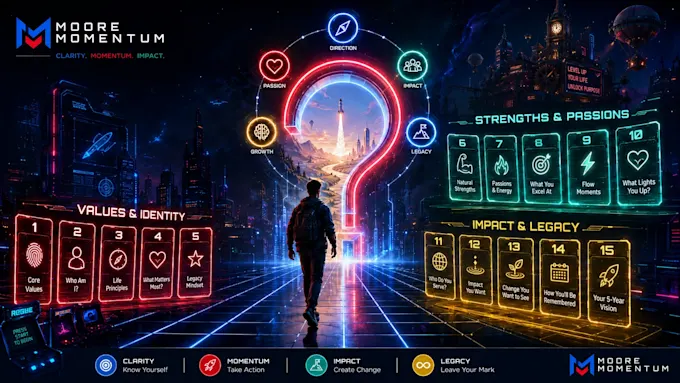
These aren't random journal prompts. They're organized into three purposeful groups—Values & Identity, Strengths & Passions, and Impact & Legacy—because how to find your purpose in life requires looking at all three dimensions in concert.
Set aside 30 uninterrupted minutes. Answer honestly. The pattern will begin to emerge.
Group 1: Questions About Your Values & Identity (Questions 1–5)
Your values are the bedrock of purpose. Without clarity here, even the most exciting goal eventually feels hollow. These five questions about life force you to strip away the noise and return to what actually matters to you.
Question 1: What would you do with your time if money were completely off the table?
This classic question works because it removes the biggest distorting lens most people use to evaluate their choices: financial necessity. Your honest answer almost always points toward something that genuinely lights you up.
Question 2: What experiences have shaped you most and what did they teach you about who you are?
Your defining moments—the wins, the losses, the unexpected turns—aren't accidents. They reveal your character, your resilience, and often the exact areas where your deepest sense of purpose is waiting.
Read More: What to do when you feel like giving up
Question 3: When do you feel most fully like yourself?
Purpose almost always lives in the moments when you feel completely authentic. Pay attention to what you were doing, who you were with, and what made it feel different from your ordinary routine.
Question 4: What values are non-negotiable for you, even when they're inconvenient?
Integrity, creativity, connection, growth, freedom—your non-negotiables reveal your identity. Purpose that violates your core values will always feel forced, no matter how prestigious or profitable it is.
Question 5: What does the fully upgraded version of yourself look like in 10 years?
This isn't about where you think you should be. It's about who you genuinely want to become. This future-self visualization is one of the most powerful tools in behavioral science for closing the gap between your current habits and the person you're trying to build.
Read More: How to Become the Best Version of Yourself
Group 2: Questions About Your Strengths & Passions (Questions 6–10)
Psychologist Martin Seligman's research in positive psychology consistently shows that purpose flourishes when strengths and passions align. These are among the most important 6 deep questions that help you find your life purpose because they locate the intersection of what you're naturally good at and what you genuinely love.
Question 6: What do people consistently come to you for help with?
Other people often recognize your strengths before you do. The things people reliably turn to you for are almost always clues to a natural ability you've undervalued.
Question 7: What activities make you lose track of time?
Mihaly Csikszentmihalyi, who pioneered the concept of "flow," found that humans are most fulfilled when deeply engaged in activities that fully absorb them. Your flow states are a direct map to your most energizing strengths.
Question 8: What topics do you find yourself reading, watching, or learning about purely for the joy of it?
When you consume information for no reason other than genuine fascination, that's a signal worth heeding. Curiosity that costs you nothing to sustain is almost always pointing somewhere meaningful.
Question 9: What challenges have you overcome that you could now help someone else navigate?
Your hardest chapters often contain your highest-value contributions. The struggles you've worked through—grief, failure, confusion, reinvention—create the exact empathy and insight needed to guide others through similar terrain.
Read More: How to Start Over in Life
Question 10: If you had unlimited resources and time, what problem would you dedicate your life to solving?
This question removes practical constraints and reveals your deepest motivations. The problems that genuinely bother you—that you think about even when no one's asking—are often at the heart of your purpose.
Group 3: Questions About Your Impact & Legacy (Questions 11–15)
These are perhaps the most clarifying 15 questions to discover your life purpose, because they force you to zoom out from the day-to-day and think about the mark you want to leave. This isn't morbid reflection—it's one of the most grounding exercises in all of personal development.
Question 11: What do you want people to say about you at the end of your life?
Not what you think they will say—what you genuinely want them to say. The gap between those two answers is often where your most important growth work lives.
Question 12: What injustice or problem in the world genuinely angers or saddens you?
Strong emotional reactions—especially anger at something unfair—are often indicators of what you were built to change. As philosopher Frederick Buechner put it, "The place God calls you to is where your deep gladness and the world's deep hunger meet."
Question 13: Who are the people you feel most compelled to serve or uplift?
Purpose almost always involves other people. Whether it's young professionals, parents, your local community, or a global cause—knowing your who often unlocks your why.
Question 14: What would you regret most NOT doing if you ran out of time tomorrow?
This question bypasses all the noise and goes straight to what actually matters to you. Regret is a powerful compass. The things that make your stomach drop when you imagine not pursuing them deserve serious attention.
Question 15: What small, daily actions make you feel like you're contributing something that matters?
Purpose doesn't have to be a single grand mission. Often, it's a thread woven through the small, consistent choices you make every day. Identifying those actions is one of the fastest ways to build momentum toward a larger purpose.
Read More: How to Self Reflect
How to Find Your Purpose Using Your Answers
Answering these questions about life is only half the equation. What you do with the answers is where the real transformation begins.
The most common mistake people make here is treating their answers as a finished map rather than as raw material. Your purpose won't arrive in a single, clear sentence after Question 15. It will emerge gradually—like a photograph developing in a darkroom as you look for the patterns across all three groups.
Here's how to extract meaning from what you've written:
Look for overlapping themes. When similar words, feelings, or concepts show up across multiple answers—especially across different groups—those are your signal. If "helping people navigate confusion" shows up in questions 6, 9, and 13, that overlap is telling you something important.
Notice the emotional weight. Some answers will feel academic. Others will feel charged. Pay much more attention to the charged ones. Emotional resonance is your nervous system confirming what your mind isn't quite ready to admit.
Identify the tension. The gap between where you are and where your answers point is not a problem—it's the actual work. Most people mistake that gap for a sign that purpose is out of reach. It isn't. It's just showing you the habits you'll need to build to close it.
Building those habits is a process. It's incremental, often uncomfortable, and always more effective when it touches more than one dimension of your life. Small wins in one area—say, clarifying your values—have a natural way of rippling outward, improving your confidence, your relationships, your sense of direction, and your overall energy. That ripple effect is not magic. It's behavioral science at work.
How to Discover Your Life's Purpose in 3 Simple Steps
If you want a practical structure for moving from reflection to real change, this 3-step approach turns your answers into actionable momentum.
Step 1: Build Awareness of Who You Are Right Now
Before you can figure out where you're going, you need an honest picture of where you stand. This means taking stock of your current habits, your emotional patterns, your strengths, and the pain points that are quietly stifling your growth.
Most people skip this step. They jump straight to goal-setting without understanding what's actually driving—or blocking—their behavior. The result is a plan that looks good on paper and collapses within two weeks.
Awareness isn't just self-reflection. It's identifying the specific areas of your life where your actions are misaligned with your stated values. When you can see that gap clearly, you can begin doing something about it.
Read More: Self-Reflection Questions for Growth
Step 2: Create a Vision of Who You Want to Become
Armed with your purpose-building answers, the next step is to construct a vivid, concrete picture of the upgraded version of yourself. Not a vague aspiration—a specific image of what your life looks, feels, and operates like when you're living in alignment with your purpose across all the key areas that matter.
Your mindset. Your work. Your relationships. Your physical energy. Your emotional wellbeing. A complete picture, not just a career goal.
Research in cognitive psychology consistently shows that people who hold a detailed mental image of their desired future are significantly more likely to take sustained action toward it. The vision is not the destination—it's the daily reminder of who you're becoming.
Step 3: Take Consistent Action Using Science-Backed Methods
The final step is where most self-help systems fail spectacularly. They tell you what to do but give you no real method for making yourself do it consistently—especially on the days when motivation runs dry.
Behavioral science has a clear answer: don't rely on willpower. Instead, design your environment and your habits to make the right actions obvious, easy, and rewarding. Make purpose-aligned habits visible in your daily routine. Reduce the friction that separates intention from action. And build in enough immediate reward that your brain starts to associate growth with something it genuinely looks forward to—rather than something it dreads.
This isn't a radical new idea. James Clear, BJ Fogg, and Charles Duhigg have all documented versions of it. The science is well-established. What's missing for most people is a system that actually applies these principles to their specific situation—not a generic 10-step plan, but a personalized approach tied to who they actually are, what they actually want, and the real obstacles standing in their way.
When purpose is paired with that kind of personalized, friction-reduced habit system, it stops being an abstract concept. It becomes the engine of your daily life.
Read More: How to Stay Consistent
Upgrades You'll Receive By Doing This Work
When you commit to asking and answering these 15 questions to discover your life purpose, here's what starts to shift:
Clarity over confusion.
The mental fog that comes from drifting without direction starts to lift. Decisions get easier when your values are clear.
Motivation that doesn't depend on willpower.
When your daily actions are aligned with something that genuinely matters to you, consistency becomes dramatically easier.
A stronger sense of identity.
You stop defining yourself by your job title or your income and start building an identity grounded in your values and impact.
Resilience when things get hard.
Purpose is one of the most well-documented buffers against burnout, anxiety, and the kind of low-grade despair that comes from going through the motions.
Progress that compounds.
When your habits, your relationships, your health, and your mindset are all oriented around a common purpose, they reinforce each other—creating momentum that builds on itself rather than stalling every few weeks.
Conclusion: Get Back to Work to Find Your Purpose
Will Moore eventually found his way out of that quiet room.
Not by stumbling onto a single, transformative answer. But by asking better questions about what he truly valued, where his energy came from, who he most wanted to serve, and what kind of legacy he actually wanted to build. Those questions, answered honestly and repeatedly, revealed a purpose that had been waiting the whole time: helping other people break free from the same hollow success trap he'd nearly been consumed by.
That's what the right question and answer about life can do for you.
You don't need another motivational quote or a new personality quiz. You need the right questions—and the courage to sit with the answers long enough to act on them.
The 15 questions to discover your life purpose in this article are that starting point. Work through them. Look for the patterns. Notice what makes you feel something. And then most importantly don't just reflect on the answers. Build habits around them.
Purpose isn't found in a moment of insight. It's built, one honest question and one purposeful action at a time.
🚀 READY TO TURN YOUR PURPOSE INTO UNSTOPPABLE MOMENTUM?
You've just done the deeper work—asking the questions most people avoid. But here's the thing: clarity without a system behind it fades fast.
The strategies in this article—values alignment, strengths discovery, identity transformation, and science-backed habit formation—are the exact foundations of the Moore Momentum System. A personalized, gamified, AI-driven platform designed to take everything you just uncovered and turn it into daily momentum across all 5 Core Pillars of Life: Mindset, Career & Finances, Relationships, Physical Health, and Emotional & Mental Health.
👉 Take the Core Values Quiz right now to get your personalized Momentum Score—a clear snapshot of where you're thriving, where you're stuck, and exactly where to focus next. It takes under 60 seconds and gives you the clarity to start building habits that actually stick.
Your purpose deserves more than a journal entry. Start living it NOW with your personalized Momentum Map HERE.
🚀🚀🚀 Don't forget to check out our Resource Arcade 👾🎮 for FREE templates and tools to gamify your habits.

FAQs About Find Your Purpose in Life
What is my purpose, and how do I find it?
Your purpose is the intersection of what you value, what you're naturally good at, and the contribution you most want to make to the world. You find it not through passive reflection but through active inquiry—asking structured questions about life, identifying patterns in your answers, and taking small, consistent actions aligned with what you discover. How to find your purpose in life is ultimately a process, not an event.
What is your purpose? How do I define mine in a sentence?
Start with this simple framework: "I exist to [contribution] for [who] so that [outcome]." It won't be perfect on the first try—and it doesn't have to be. Treat it as a working definition that evolves as you do. The goal isn't a perfect mission statement. The goal is enough clarity to start moving in the right direction.
How to find purpose of life when I feel completely lost?
When you feel lost in Life, the worst thing you can do is wait for clarity to arrive. Instead, start with the smallest, most answerable questions. What makes you angry? What makes you lose track of time? Who do you most want to help? Loss of direction is usually a symptom of misalignment—your daily actions are out of sync with your actual values. The 6 deep questions that help you find your life purpose in the Strengths & Passions group above are the best place to start when you feel stuck.
How to find your purpose in life if you've already tried everything?
If traditional approaches like journaling, reading, therapy, personality tests haven't produced clarity, it's usually because the answers have stayed theoretical. Purpose clarifies fastest through action, not reflection alone. Choose one answer from these 15 questions to discover your life purpose that felt most charged or uncomfortable, and build a small daily habit around it. Action generates clarity in a way that thinking alone rarely does.
How to discover your life's purpose in 3 simple steps?
A helpful way to start is with this three-step framework: Build Awareness, Create a Vision, and Take Consistent Action.
First, get honest about where you are right now. Then, define where you want to go. Finally, take small, steady steps that make progress feel realistic instead of overwhelming.
This approach works because it follows the same basic pattern used in many evidence-based behavior change programs: understand your current habits and mindset, set a clear direction, and use practical strategies to keep moving forward. The real key is to make each step personal. Your purpose will be easier to uncover when you shape the process around your strengths, challenges, values, and real-life circumstances—not around a one-size-fits-all formula.


Founder & CEO of Moore Momentum
Will Moore is a serial entrepreneur, life coach, and habit science expert with a $300M+ exit under his belt. After hitting suicidal rock-bottom as a teen, he dedicated his life to cracking the code on lasting happiness and success — and built Moore Momentum to share what he found.
He helps people discover WHO they are, WHAT they really want, and HOW to get there by combining proven principles, science, AI, and gamification.
His mission: make growth ethically addictive and inevitable.