





How to Win at Life: 10 Proven Tips
I used to think winning at life meant a certain car, a certain zip code, and a bank account with no ceiling on it.
Then I sold my company for a $300M+ exit, sat in the house I'd wanted for fifteen years, and felt almost nothing. Not relief. Not pride. Just a low hum of "is this it?" On paper I had won. In my own head I was stressed, disconnected from the people closest to me, and running on fumes. I'd spent two decades optimizing for a scoreboard that turned out to measure the wrong thing.
That gap is what taught me how to win at life in a way that actually holds. It isn't money. It's momentum. You don't win by crossing one finish line and stopping. You win by building systems that keep you moving forward in your mindset, your health, your relationships, and your finances at the same time, so progress becomes the default instead of the exception.
Below are the 10 strategies that took me from a suicidal rock bottom at 20 to a life I'd actually choose again. This is the playbook I wish someone had handed me 25 years ago.
How Do You Win at Life?
To win at life, define success by your own values instead of borrowed ones, then build small daily habits across five areas: mindset, career and finances, relationships, physical health, and emotional health. Winning at life is not one breakthrough. It is momentum compounding across every area at once, until forward progress becomes your default setting.
That's the short version. The next 3,000 words are the part that makes it stick.
What Does It Mean to Win at Life?
Winning at life means living in alignment with your core values while consistently growing across the areas that carry the most weight: mindset, relationships, finances, physical health, and emotional well-being. It has very little to do with hitting a number or clearing a milestone, and almost everything to do with progress, fulfillment, and being able to sit alone with yourself.
Five things it actually looks like day to day:
Alignment: Your calendar and your values match. Most people's don't, and they can feel the friction without being able to name it.
Momentum: You're moving. Slowly counts. Stalled doesn't.
Resilience: You get knocked down and you get back up faster than you used to.
Presence: You're not spending the whole day in regret about last year or anxiety about next year.
Connection: You love people, and you let people love you back. That second part is harder than it sounds.
Nobody is born knowing this. You learn it, you practice it badly for a while, and then you keep redefining it as you change. Life isn't something you win once. It's something you get better at, one habit and one honest conversation with yourself at a time. If you want to go deeper on what that fulfillment actually feels like from the inside, start with what true happiness really is, because it looks nothing like the version most of us were sold.
Key Takeaways: How to Be a Winner in Life
Build a growth-owner mindset first. Every other strategy on this list runs on it.
Set goals that come from your own values, not from comparison or obligation.
Design habits and environments so the right move is the easy move, instead of relying on willpower.
Protect your relationships, your energy, and your money with the same seriousness you protect your career.
Progress beats perfection. Being 1% better today compounds faster than any single heroic push.

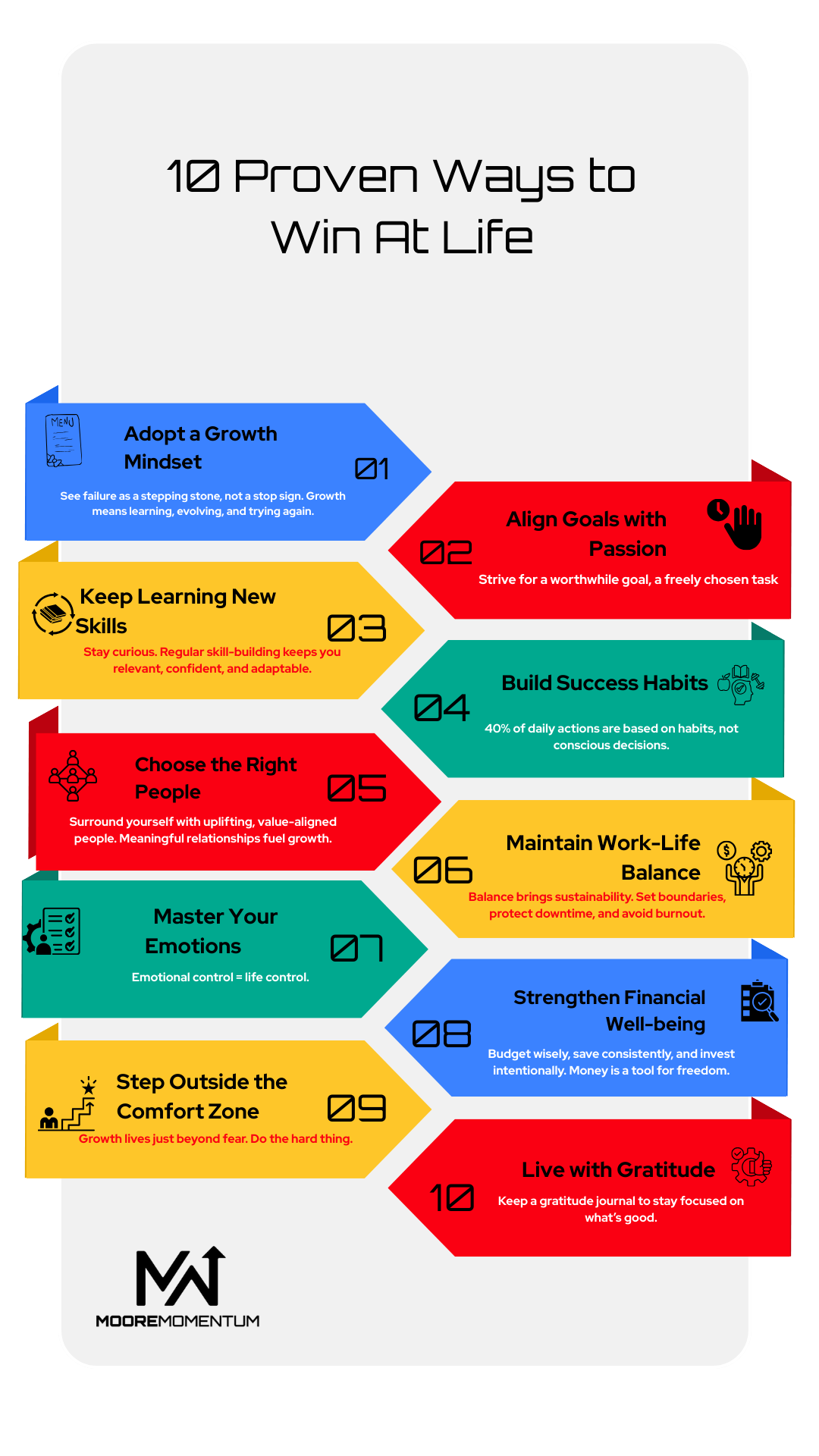
10 Proven Ways of Winning at Life
1. Build a Growth-Owner Mindset
A fixed mindset is a trap with a very comfortable interior. It keeps you in a loop of fear and avoidance that shows up as analysis paralysis, endless "research," or quitting a project the second it gets awkward. If you've ever spent three weeks choosing a course you never started, you know exactly what I mean. Understanding why a fixed mindset is such a hindrance is usually the first crack in the wall.
The alternative is what I call a growth-owner mindset. Growth, because you treat ability as something you build rather than something you were issued at birth. Owner, because you stop assigning the blame elsewhere. Obstacles become temporary, not permanent. Failure becomes information, not a verdict.
This isn't motivational poster material. In a national experiment published in Nature, Yeager and colleagues delivered a short online growth mindset intervention to more than 12,000 US ninth graders and found improved grades among lower-achieving students and increased enrollment in advanced math courses. Two brief sessions. Measurable change in trajectory. The belief you hold about whether you can change is not a soft variable.
So how do you build it? Start by noticing that every person you admire has a highlight reel and a landfill. What separates them is that they mine the landfill. When something fails, they extract the lesson and run the next rep. That's it. That's the whole trick, and it's why developing a growth mindset is the highest-leverage thing on this list.
As Idowu Koyenikan put it: "The mind is just like a muscle. The more you exercise it, the stronger it gets and the more it can expand."
2. Align Your Goals With What You Actually Want
Here's a question that ruined a good six months for me once I finally asked it honestly: whose goals are these?
Real fulfillment shows up when your targets reflect your own values instead of your parents' expectations, your feed's highlight reel, or a version of you from ten years ago who no longer exists. Chasing a goal you don't want is exhausting in a way that chasing a goal you do want simply isn't. Same hours. Completely different fuel.
Viktor Frankl, who survived Auschwitz and then wrote the definitive book on meaning, said it better than I can: "What man actually needs is not a tensionless state but rather the striving and struggling for a worthwhile goal, a freely chosen task." Note the word freely. Tension isn't the problem. Borrowed tension is.
Before you set another goal, run this audit:
Do my current goals give me energy, or do I feel a small dread when I think about them?
Where in my life do I feel the most disconnected from what I'm actually doing?
Am I chasing this out of genuine desire, or out of fear, comparison, or obligation?
Self-awareness is unglamorous and it is the entire foundation. It surfaces the quiet stuff, the negative self-talk and scattered focus, that sabotages you long before any external obstacle gets the chance. If those questions left you staring at the ceiling, figuring out what to do with your life is the right next stop.
3. Keep Learning New Skills
"Live as if you were to die tomorrow. Learn as if you were to live forever." Gandhi got there first.
To level up in life, you have to keep adding tools. New skills keep you adaptable, keep you employable, and keep you interesting to yourself, which matters more than people admit. A global Statista survey found that 76% of Gen Z respondents see continuous learning as key to career success, which tells you where the baseline is heading.
But most people never start, because they've absorbed a myth about the time it takes. You've heard the number. The reality is more complicated and far more encouraging, and reading how many hours does it take to master something will probably save you a couple of years of hesitation. Short version: deliberate practice beats accumulated hours, and useful competence arrives long before mastery does.
A workable sequence:
Pick something with pull. Curiosity outlasts discipline. Choose a skill you'd read about on a Saturday.
Start embarrassingly small. Twenty minutes. Basics only.
Practice on a schedule, not a mood. Same time, same place, every time.
Get feedback early. Practicing wrong for six months is worse than not practicing.
Use it in public. Applying a skill in a real situation teaches you more in an hour than a month of tutorials.
4. Develop Success Habits That Run Without You
Here's the part nobody mentions about how to be a winner: winners are not out-deciding you. They're out-defaulting you.
In a landmark set of diary studies, Wood, Quinn, and Kashy (Journal of Personality and Social Psychology, 2002) found that roughly 43% of everyday behavior is repeated in the same context almost daily, driven by habit rather than active choice. Close to half your day is already on autopilot. The only real question is who wrote the code.
That's why keystone habits are worth so much more than the effort they cost. Some habits don't just improve one thing. They restructure everything downstream. Lock in a consistent bedtime and watch what happens to your patience, your workouts, and your food choices without you touching any of them directly. Find one of those and you get four wins for the price of one.
How to Form Success Habits
Start absurdly small, then anchor the new habit to something you already do without thinking. Want to read more? Read for ten minutes immediately after you brush your teeth. Brushing your teeth becomes the cue, so you're not burning willpower trying to remember. This is the entire mechanism behind habit stacking, and it works because you're borrowing an existing neural groove instead of digging a new one from scratch.
Then give it time, and give yourself an accurate expectation of how much. The honest answer to how many days it takes to form a habit is not 21, and it varies enormously by person and behavior. Knowing the real range is what stops you from quitting on day 24 and concluding you're just not a disciplined person.
One correction worth making, since this quote gets used constantly: "We are what we repeatedly do. Excellence, then, is not an act, but a habit" was written by Will Durant in The Story of Philosophy (1926), summarizing Aristotle. It's almost always credited to Aristotle directly. Durant deserves the line, and the idea holds either way. You are what you repeat, whether or not you chose the repetitions.
5. Choose the Right People: Relationships Are How to Be a Winner in Life
If you only implement one thing from this article, make it this one.
The Harvard Study of Adult Development has tracked the same participants for more than 80 years, through careers, marriages, wars, and retirements. Its clearest finding is almost annoyingly simple: the quality of your close relationships is the strongest predictor of long-term health and happiness. Not income. Not cholesterol. Not social class. Who you're close to, and how close.
I learned this the wrong way around. During the Doorstep Delivery years I told myself the relationships would still be there when I had time for them. Some were. Some weren't. Nobody sends you a warning email before a friendship quietly expires.
So audit your inner circle the way you'd audit a budget. The right people share your personal core values, tell you the truth when it's inconvenient, and leave you more capable than they found you. The wrong ones aren't villains. They're just a slow tax. Notice who you are in the twenty minutes after you see someone, and you'll have your answer.
Read More: How to Heal From a Toxic Relationship
6. Maintain Work-Life Balance to Keep Winning in Life
Winning in life is not the same as winning at work, and confusing the two is the most expensive mistake I made in my thirties.
Burnout isn't a badge. A WHO and ILO joint analysis covering 194 countries found that working 55 or more hours per week is associated with substantially elevated risk of stroke and ischemic heart disease compared with a standard 35 to 40 hour week. The hustle you think is buying the win is billing you for it with interest.
Balance in life isn't the opposite of ambition. It's the delivery mechanism for it. Practically, that means:
Setting a hard stop on your workday and treating it like a meeting you can't move.
Protecting at least one block a week that has no productive purpose whatsoever.
Refusing to let any one area run a permanent deficit, even a profitable one.
This is exactly the logic behind tracking your progress across the 5 Core Areas of Life rather than pouring everything into a single area and calling the imbalance a strategy. You cannot outperform your way out of a life that only has one working cylinder.
Read More: 12 Stages of Burnout
7. Manage Your Emotions Like a Pro
Winners feel everything. They just don't hand over the wheel.
Emotions shape your decisions, your relationships, and the story you tell yourself about both. Learning to work with them is a trainable skill, not a personality trait you either got or didn't. The American Psychological Association points to reframing, labeling what you're feeling, and pausing before reacting as core techniques, and they're effective precisely because they're boring and repeatable.
What this looks like in practice:
Name it: "I'm anxious about the call at 3" beats a vague sense of dread all afternoon. Naming an emotion reliably lowers its volume.
Find the trigger: Most emotional blowups have a pattern behind them. Yours is probably three or four situations on repeat.
Insert a gap: Ten seconds between stimulus and response is the difference between a reply you regret and one you don't.
Talk to yourself like someone you like: The internal monologue that would end a friendship shouldn't get a pass just because it's yours.
Getting this right is a genuine multiplier, which is why emotional wellness belongs in any serious conversation about a successful life rather than being treated as an optional extra.
Read More: How to Stop Being Judgemental
8. Master Financial Well-Being
Money doesn't buy happiness, but financial stress absolutely buys misery. Ask me how I know.
The Consumer Financial Protection Bureau defines financial well-being as having control over day-to-day finances, capacity to absorb a shock, being on track toward your goals, and having the freedom to make choices that let you enjoy life. Notice that none of those four require being rich. They require being deliberate.
The moves that matter, roughly in order:
Build a buffer before you build a portfolio. One month of expenses changes how you sleep.
Automate the saving so it happens before you can talk yourself out of it.
Kill high-interest debt aggressively. It's the only guaranteed return you'll ever get.
Fix the impulse spending loop, which is a habit problem wearing a finance costume.
Invest steadily and boringly, then stop checking it.
Most of this comes down to defaults rather than discipline, which is why building better money habits does more for your net worth than any single clever decision.
9. Step Out of the Comfort Zone
The comfort zone is where dreams go to die, and here's the part people leave out: your brain is actively engineering it that way. It wants you safe, warm, and stationary, because for most of human history that's what kept you alive. To win at the game of life you have to deliberately trigger the discomfort your biology is working to help you avoid.
I've done this at every level of my career and it has never once gotten easier. Making the first pitch for Doorstep Delivery, walking into the room where a $300M+ exit was being negotiated, hitting record on the first video where I talked about being suicidal at 20. Same knot in the stomach every time. Same voice telling me to stay put.
Winners aren't fearless. They just refuse to let fear drive.
Start ridiculously small. Do one thing today that makes you mildly nervous. Make the call you've been drafting in your head. Send the email. Ask the question in the meeting. Lean into that discomfort consistently and your comfort zone expands to include it, which is the whole mechanism behind getting out of your comfort zone for good. What terrified you in March becomes your baseline by September.
10. Live With Gratitude No Matter the Circumstances
This is the one I resisted the longest, because it sounded soft. It isn't.
In a controlled experiment, Emmons and McCullough (Journal of Personality and Social Psychology, 2003) had participants keep weekly logs. One group recorded things they were grateful for, another recorded hassles, a third recorded neutral events. The gratitude group reported higher well-being and greater optimism. Same lives. Different attention. Different outcomes.
Gratitude isn't pretending things are fine. It's refusing to let the difficult parts monopolize your attention. In practice:
Write down three specific things weekly. Specific matters. "My wife" is weak. "My wife covered for me on Thursday when I was underwater" works.
Thank people out loud, including people who don't expect it.
Notice the ordinary machinery of your life that quietly works. Hot water. Working knees. A friend who picks up.
Stay in the present tense, where the good stuff actually lives.
Living in gratitude takes about ninety seconds a week and changes what your brain looks for by default. That's an absurd return on investment.
Want a structured starting point? Download our free Gratitude Guide and take the first step toward a more balanced, appreciative life.
Inspiring Quotes About How to Win in Life
Keep these somewhere you'll actually see them.
"You were born to win, but to be a winner, you must plan to win, prepare to win, and expect to win." — Zig Ziglar
"You've got to get to the stage in life where going for it is more important than winning or losing." — Arthur Ashe
"Victory is in having done your best. If you've done your best, you've won." — Bill Bowerman
"Winning is about struggle and effort and optimism, and never, ever, ever giving up." — Amby Burfoot
"Winning is not a sometime thing; it's an all the time thing. Winning is a habit." — Vince Lombardi
Summary: How to Be a Winner, Starting Today
Winning at life was never about being perfect. It's about being 1% better today than yesterday, and then doing that again tomorrow.
I still have bad weeks. I lose focus, drop a habit, snap at someone I love. The difference between now and the version of me sitting in that empty house is that I have a system to get my momentum back, instead of a guilt spiral that costs me another month.
That's the real answer to how to be a winner: stop trying to want it more, and start making the right move the easy move. When you gamify your life, discipline stops feeling like a tax and starts feeling like progress you can actually see.
The 10 strategies above compound in sequence. A better mindset produces better habits. Better habits produce stronger relationships. Stronger relationships fuel the financial and emotional stability you've been chasing the long way around. None of them work alone. All of them work together.
Start with one. Today.
🏆 READY TO STOP PLAYING ON EASY MODE?
Winning at life isn't about one big breakthrough. It's about the right system. Every strategy in this article comes straight from the Moore Momentum System: a science-backed, AI-personalized, gamified platform that turns the grind of self-improvement into something you actually want to do every day.
👉 In under 60 seconds, take the Core Values Quiz to uncover exactly which of your 5 Core Areas is draining the most momentum, and get a personalized roadmap for where to focus first.
Because the players who win aren't the ones who try harder. They're the ones who finally found the right game to play.
🚀🚀🚀 Don't forget to check out our Resource Arcade 👾🎮 for FREE templates and tools to gamify your habits.

FAQs About How to Win at Life
What does it mean to win at life?
Winning at life means achieving success and contentment on your own terms rather than borrowed ones. It's living in alignment with your values, growing steadily across mindset, relationships, health, and finances, and being genuinely at peace with the life you're building. It's defined by personal fulfillment, not by external milestones or comparison.
What is the best way to win at life?
The best way to win at life is to live with purpose instead of reacting to whatever arrives. Set clear goals that reflect your actual values, then take small consistent daily action toward them. Define what success looks like specifically for you, whether that's health, freedom, or connection, and reverse-engineer the steps from there.
What are the 6 laws to win in life?
Six principles show up repeatedly among people who win consistently. Clarity: know exactly what you want and why. Discipline over motivation: motivation fades, habits don't. Fail forward: every failure carries usable data. Protect your energy: it fuels everything else. Choose your circle carefully: it shapes your standards. Stay adaptable: conditions change fast.
How do you win at everything?
You don't win at everything, and chasing that is a fast route to burnout. What high performers actually do is build systems that make good outcomes likely across the areas that matter most. Clear priorities, strong default habits, protected time and energy. They rely on structure rather than motivation, and they accept losing in areas they've deprioritized.
What is the secret to winning in life?
There's no single secret, but four patterns separate people who win consistently. Discipline over motivation. Systems over willpower. Purpose over popularity. Learning over ego. Winners build routines that carry them toward their goals automatically, so success doesn't depend on how they happen to feel on any given morning.
How do I get success in my life?
Start with a specific vision of what success means to you, not what it means to your feed. Break it into monthly, weekly, and daily targets. Build habits that move you toward it without daily negotiation. Surround yourself with people who raise your standards. Then track your progress honestly and adjust when the data disagrees with you.


Founder & CEO of Moore Momentum
Will Moore is a serial entrepreneur, life coach, and habit science expert with a $300M+ exit under his belt. After hitting suicidal rock-bottom as a teen, he dedicated his life to cracking the code on lasting happiness and success — and built Moore Momentum to share what he found.
He helps people discover WHO they are, WHAT they really want, and HOW to get there by combining proven principles, science, AI, and gamification.
His mission: make growth ethically addictive and inevitable.